
"What on Earth?"
Article and Photos by Ray Barbehenn
Cicada larvae live quiet lives underground, sucking on the watery sap of tree roots. However, when they finally tunnel to the surface to turn into adults, it's party time! The loud, repeated calls of the males attract females, but they also get the attention of the whole forest, including the birds and other predators. During years when the 17-year periodical cicadas emerge (with over a million cicadas per acre in some areas), their combined volume sounds like an alien invasion. After they breed and lay their eggs, the adults die, and the tiny larvae start another generation underground. The annual cicadas will be out calling again the following year, but it will be a 17-year wait for the periodical cicadas to emerge again from each of their "broods."
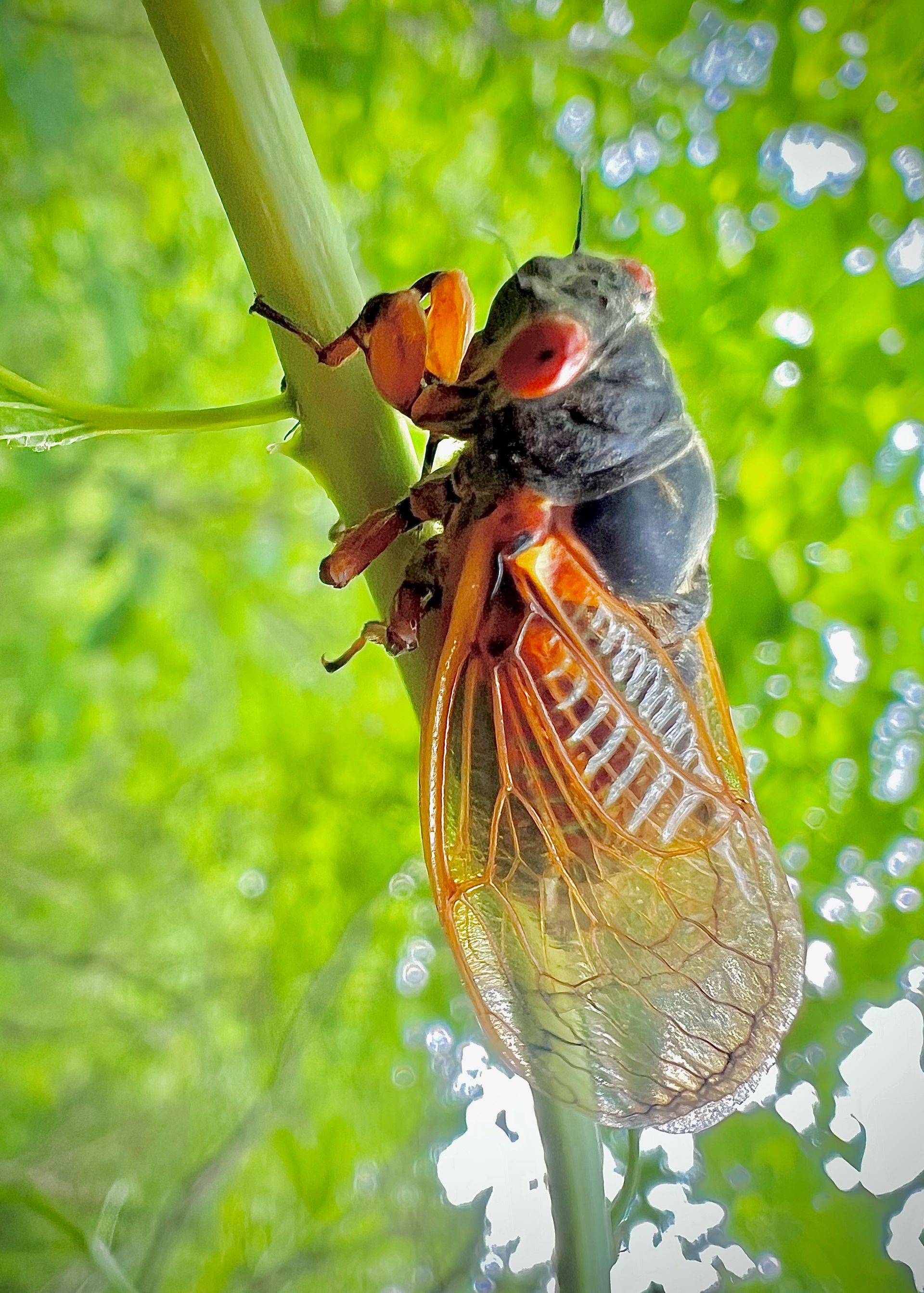
There are both periodical and annual cicadas in our area. The left photo shows a 17-year periodical cicada (probably
Magicicada cassini), which was found in Duke Hollow (near the AT in northern Virginia) on May 18, 2025. (The photo was flipped for better comparison of the two species.) Notice its red eyes and its red-brown wing veins and legs. Their eyes only change from white to red when the larvae are ready to emerge and will need to look around! Its needle-like mouthparts were lowered between its large front legs, perhaps preparing to feed on the plant's sap. Also notice its short, hair-like antennae, which are present on all cicadas.
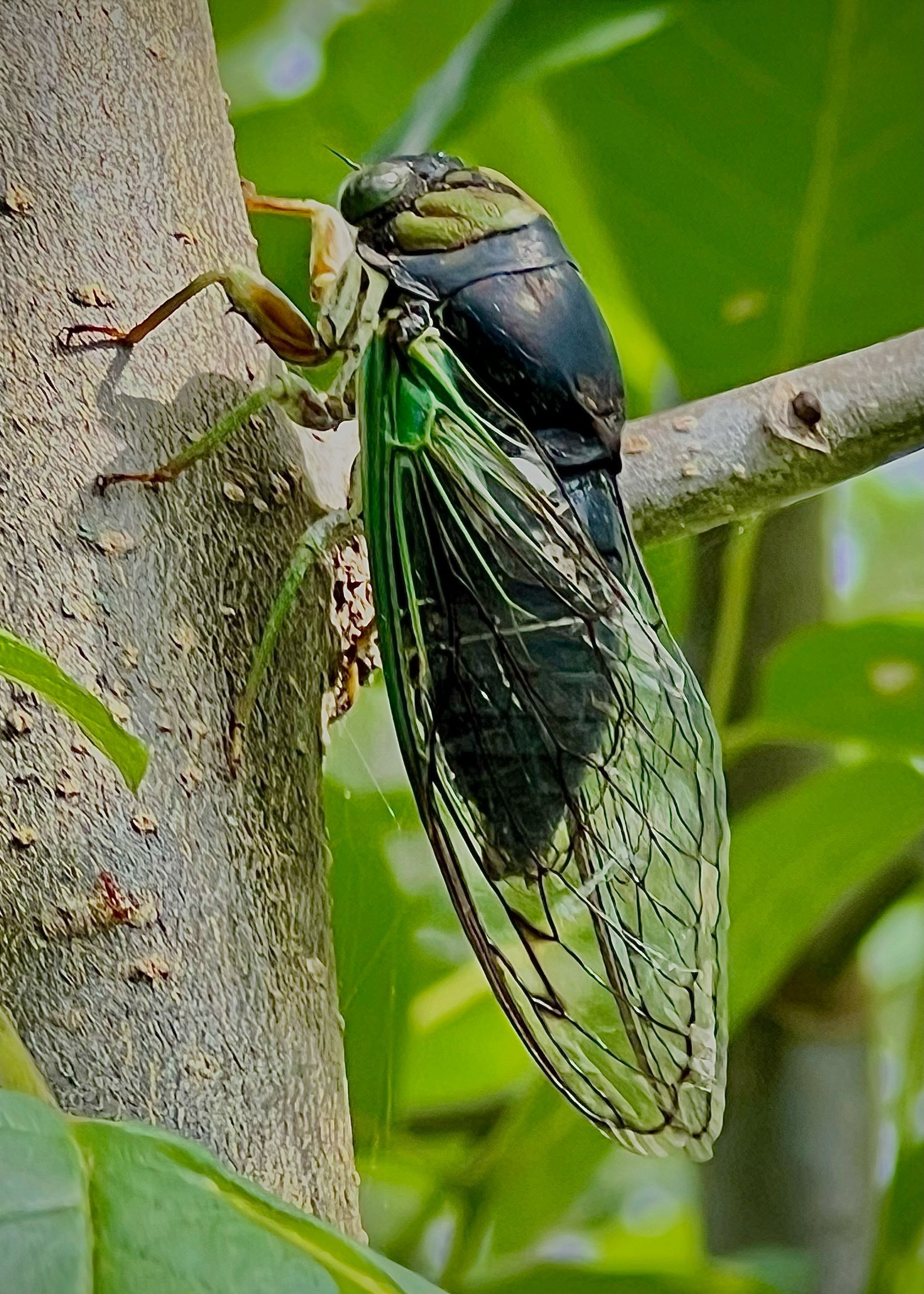
The right photo shows an annual cicada (probably
Neotibicen
tibicen). I was able to walk right up to it while it was making its loud, whining buzz on July 23, 2025 (also in Duke Hollow). Notice the green veins near the base of its clear wings and its dark eyes. Both species are large insects, up to two inches long from their heads to the tips of their wings.
How do 17-year periodical cicadas know when to emerge?
A. The larvae have to grow to a "critical size."
B. The larvae respond to the spring flushes of sap in the trees' roots.
C. A and B
D. Unknown.
The answer is near the bottom of the article!
Fun Facts and Musings
Among the 3400 cicada species known on Earth, there are just seven "periodical" species. These are species that synchronize their mass emergences after years underground. The periodical species all live in the eastern and central United States. The three species of 17-year periodical cicadas live in our area, while the four 13-year species live just to the south of these species, with little overlap between the 17-year species and 13-year species. By comparison, there are over 20 species of annual cicadas in different parts of our area.
Cicadas may complain loudly if they are handled, but they do not bite, sting, or contain noxious chemicals. In addition, they usually do little damage to the forest trees on which they feed and lay eggs. Of course, anyone with an orchard or a nursery of saplings might reasonably disagree after an outbreak; the females insert their eggs into the twigs of trees, which can kill the branch ends.
Swarms of periodical cicadas were mistakenly called locusts by startled European settlers at least as far back as 1666. (See Oldenburg, H. 1666. Some observations of swarms of strange insects and the mischiefs done by them. Royal Society of London, Philosophical Transactions 1:137.) However, cicadas are unrelated to locusts, which are a type of grasshopper.
The only food that cicada larvae grow on is the watery sap in roots known as "xylem" fluid. This sap is about 99% water! Even more challenging, the 1% of the sap that is nutritional does not provide the complete nutrition that an insect needs to grow. How can cicadas possibly grow on this sort of food? The answer is the symbiotic bacteria inside the cicadas.
We now recognize that there are "good bacteria" in our digestive tracts, but they stay inside there, mixed with the food we eat. What is amazing about the good bacteria in cicadas is that they house them in clusters inside their bodies, rather than in their digestive tracts! These specialized bacteria have been passed from cicada generation to generation for many millions of years. They enter the cicada mother's eggs as they form in her ovaries. These symbiotic bacteria make the missing essential nutrients that cicadas require to grow, and in return the bacteria have safe homes in which to live.
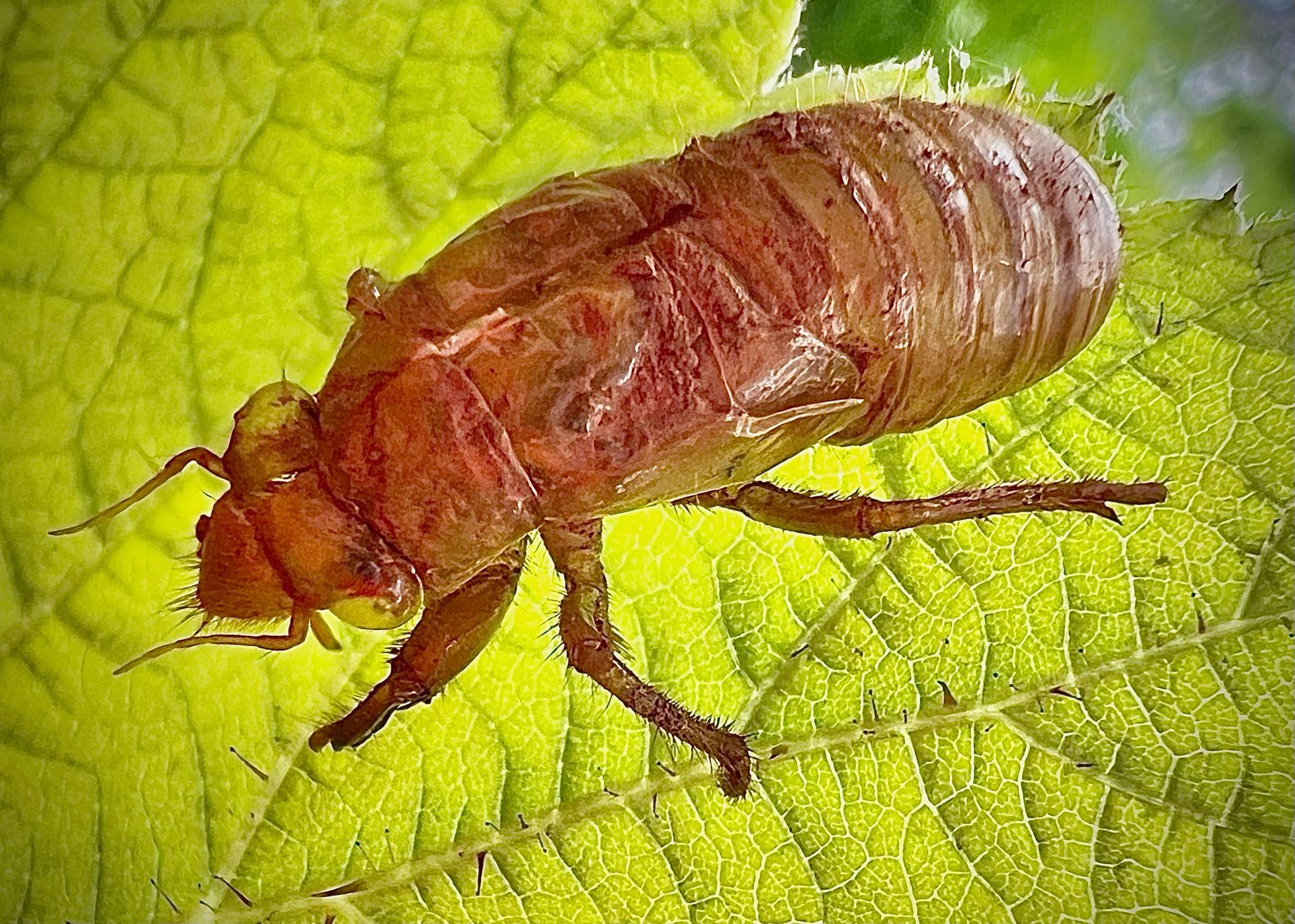
You have probably seen the shells of larval cicadas attached to all sorts of things. The one pictured below was in Duke Hollow on May 18, 2025. This inch-long shell was hooked by its claws to the undersurface of a Wineberry leaf. Notice the split down its back where the adult broke out. Also notice the massive front leg segment next to its left eye. The front legs have powerful muscles for tunnelling through the soil in search of roots. Almost any kind of tree root will do; both periodical and annual cicada larvae feed on most species of deciduous trees.
What is odd about this find is that there were not supposed to be 17-year periodical cicadas emerging in northern Virginia in 2025. 2021 was the year of the great emergence. This insect was a "straggler" – a 21-year-old cicada larva! When stragglers emerge, they are usually off by either one or four years, but they can be either too late or too early. Indeed, it is believed that the 13-year periodical cicadas in the south split off from 17-year periodical cicadas by starting to emerge four years earlier.
Despite their name, "annual" cicadas do not have an annual life cycle. Their larvae actually need three to five years to develop! But they are not all in sync with each other, so there are annual cicadas that emerge every summer. (This means that they are not considered periodical.)
Why do 17-year periodical cicadas wait so long and emerge all at once? Seventeen years is the longest development time of any insect species on Earth! The vast majority of insect species have a one-year life cycle. And, annual cicadas, feeding on the same tree roots as periodical cicadas, can develop over five-times faster to reach the same body size as periodical cicadas. The periodical cicadas appear to be intentionally slowing down their growth rates! (Presumably, the hormones that promote their growth rates have been greatly decreased.) There must be some benefits that explain why this alternative strategy works well in rare instances like this.
Not surprisingly, the favored explanations for slower development times are increased survival and improved reproduction. When there are millions of cicadas flying about, the predators eat them until they are satiated, but most (about 85%) of the cicadas survive. Although the predators get to feast and raise many of their own young during a boom year, their numbers dwindle back to normal during the bust years; the long gaps between emergences keeps predators from building up their populations at the expense of the cicadas. In a huge population of periodical cicadas, it is not so dangerous for the males to make loud calls that alert predators to their whereabouts. Reproductive success is also greatly improved when there are millions of your kind flying about. So, the cicadas wait very patiently and then all arrive to the party together.
How do periodical cicadas count to 17? They don't. Our best understanding is that they know when to emerge based on a combination of the annual spring flush of sap in the roots and their body size. Trees provide an annual clock for sap-feeders: Each spring, the watery sap in tree roots becomes concentrated with nutrients to send up to the leaves, which continues only until they have expanded. That means the larva's food becomes especially delicious and nutritious for a limited time each spring. This nutritional boost gets the attention of the larvae, as can be demonstrated by fooling them! If one places 15-year-old larvae on tree saplings that are artificially made to go through two "spring flushes" in one year, the extra flush causes the larvae to emerge a year early. They become "16-year periodical cicadas" (according to our sense of time). In other words, cicada larvae are paying attention to the trees' annual cycles, rather than to a 12-month calendar year. Secondly, larval insects can tell when it is time to molt when they get too tight inside their shells ("exoskeletons"). So, after 17 years and five stages of growth, when they reach a "critical size" and the spring sap is flowing, they all know that it is time to emerge.
Answer: C! But if you thought it was "D" because the answer is still a work in progress, I could agree with that too.
Send your photos and ideas for topics to Ray at rvb@umich.edu.
P.S. Save the Beech trees in your area this spring while you still have a chance! See "phosphite" treatment in the following article for a cost-effective method:
<<Previous Article Back Home Next Article>>