
Keep Calm and Read On
By Wayne Limberg
Keep Calm and Read On: Saving America's Best Idea
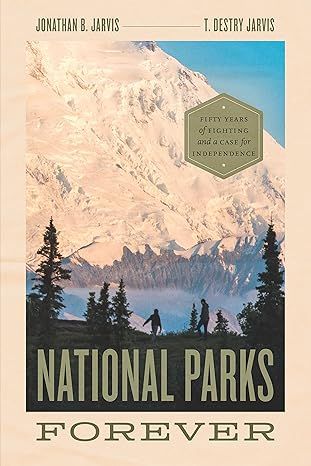
In "National Parks Forever," Jonathan and Destry Jarvis remind us that making laws and sausages is not for the faint hearted. The book unfortunately got little attention and few reviews when it appeared in the middle of the pandemic for it is a must read for anyone interested in the future of national parks. It is available online, including an audio version on YouTube. The authors call for moving the National Park Service out of the Department of Interior and making it an independent agency.
The Jarvis brothers bring 90+ years of experience in national parks to bear. Jonathan began working for the NPS during the Bicentennial. Two years later he became a GS-5 Ranger in Prince Williams Forest. Over the next two decades, he worked in four national parks before becoming superintendent of Craters of the Moon NP and then Wrangell-St. Elias and Rainier NPs. In 2009, after serving as the director of the NPS Pacific West Region, he became the 18th NPS director.
On returning from Vietnam in 1972, Jonathan's older brother Destry worked as a volunteer lobbyist for Friends of Animals, which led to 16 years with the National Parks Conservation Association and eight with National Geographic and the Student Conservation Association before Clinton appointed him an assistant director of the NPS. In 2000 he returned to the private sector.
The Jarvis brothers argue that since 1972, the NPS has increasingly been the victim of partisan politics and whims of the DOI and White House. Before 1972, directors of the NPS were professionals largely free to pursue the service's prime directive: preservation of national parks "unimpaired for the enjoyment of future generations." They were not expected to resign with each new administration, serving an average of eight years. Secretaries of the Interior in those years rarely intervened or overruled their decisions; NPS directors had direct access to the Secretary.
Whether controlled by the Democrats or Republicans, Congress generally confined its role to authorizing and funding new parks. By the 1970s, however, bipartisan support was eroding. Nixon expanded White House control over the federal bureaucracy with the creation of the Office of Management and Budget and the role of assistant secretaries in federal agencies, giving them the power, in the case of the DOI, to sign off on the selection park superintendents. Nixon replaced the director of the NPS in 1972 for the first time in history with a political appointee.
From 1972 on, the directorship was a political football with each administration choosing directors that fit its priorities. By 2020 the average tenure of a NPS director declined to four years with political appointees occupying the office roughly half the time. Plus, NPS directors now have upwards of ten levels of bureaucracy to penetrate before getting to the Secretary. Long term planning has become ever harder as the NPS has to devote more time and energy to defending its basic mission, employees and budget. In 1998, Congress passed legislation requiring NPS directors be confirmed by Congress, but this led to the Trump administrations to appoint acting directors who do not require confirmation.
The Jarvis brothers blame Republican administrations since 1972 for most of the politization of the NPS, citing their ties to mining, oil and timber industries. They do not entirely spare the Democrats, however. While Democratic administrations over the last 50 years doubled the acreage under NPS control and were more likely to resist commercial intrusion, they often failed to increase NPS budgets sufficiently to handle the new responsibilities or make executive orders permanent through legislation. At times they too put constituent over national park interests and welfare.
Interagency rivalries also factor into the authors’ argument for an independent NPS. The NPS-USFS rivalry is well-known. Within the DOI, the NPS often is at loggerheads with the Bureaus of Land Management and Fish and Wildlife, whose basic missions, like USFS, include the extraction of natural resources and as such stand in stark contrast with the NPS mission of preservation. In practice, this gives administrations, congress and commercial interests avenues to counter NPS initiatives and policy.
"National Parks Forever" is more than a call to action. It’s also a textbook on how NPS park policy is created and enacted. The book’s first chapter is an excellent overview of NPS history. The following five chapters are case studies. Chapter 3, for example, looks at the struggle to increase the role of scientific and historical research in park management, while Chapter 5 examines the job NGOs play in park management; the ATC earns high praise. But "National Parks Forever" is not just a tome for policy wonks and park nerds. The authors prove that government officials can write. Throughout the book, they provide first-person accounts of how, in the case of Destry Jarvis, NGOs like the NPCA advanced a given policy and in the case of his brother Jonathan, this played out inside the government.
When the Jarvis brothers went to press in 2022, they believed it was time for change. They include a chilling indictment of the first Trump Administration. In making the case for the NPS becoming an independent agency, they ask readers to imagine a time when the Smithsonian--a rough example of what they have in mind for the NPS--was ordered to revamp its exhibits to conform to the views of any given administration. Along with a list of specific reforms, they conclude "National Parks Forever" with a hope that Americans together to ensure that national parks are, in the words of Teddy Roosevelt, "preserved…forever, with their majestic beauty all unmarred."
Have a good read? Send it to wplimberg@aol.com. Meanwhile, keep reading. See you on the trail.