
Keep Calm and Read On: Way Out West
By Wayne Limberg
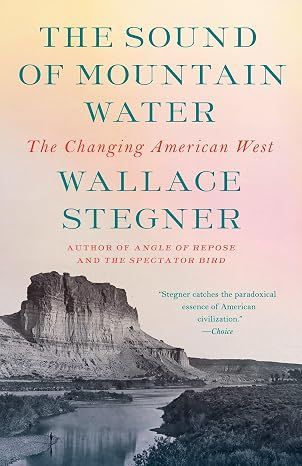
Readers of past reviews will immediately recognize this month's featured author, Wallace Stegner. He is generally regarded as the dean of the Western school of American writing. In a career spanning six decades, he wrote 14 novels, including "Angle of Repose," which won the Pulitzer Prize in 1971 and "The Spectator Bird," which won the National Book Award in 1976. In addition, he taught at University of Wisconsin and Harvard and founded the creative writing program at Stanford University, whose alumni include Sandra Day O'Connor, Ken Kesey, Larry McMurtry, and Edward Abbey. Stegner wrote another 16 non-fiction books. Among them is this month's selection, "The Sound of Mountain Water," a collection of essays Stegner wrote between 1946 and 1969. It chronicles the challenges his beloved West faced in the postwar years and his evolution as a writer and environmentalist.
Stegman’s introduction to "The Sound of Mountain Water," which he wrote when the book came out in 1979, explores the idea of the West in American thinking. His definition of the West and western is as much story of what they are not as what they are. It is not California, which is a bit ironic given Stegman's years at Stanford and his years on the executive board of the Sierra Club. For Stegner the "West" was the land west of the 100th meridian to the Sierra Nevadas, bounded by mountains, deserts and prairies where water is the biggest problem.
Nor does "western" mean cowboys even though Stegner considers "The Oxbow Incident" by Walter Van Tilburg Clark and "The Virginian" by Owen Wister prime examples of the western school of writing. He rejects Hollywood’s image of the gunslinger cowboy who all too often breaks the law in the name of justice. Drawing on his childhood years in Montana, Utah, and Saskatchewan, he saw the farmers, miners, and teachers as the true westerners.
Stegner divides "The Sound of Mountain Water" into two parts. The first contains essays he wrote between 1946 and 1965 and are at once odes to the magic and beauty of the West and cautionary tales of what man has wrought. "Navajo Rodeo,” written in 1949, describes the simple charm of roadside attractions in Arizona and then charts how commercialization all but destroyed them. In another, Stegner catalogs the serene beauty he encountered on a 1948 float trip down Glen Canyon; another written 17 years later describes how the damming of the Colorado and creation of Lake Powell erased much of that beauty. The section ends with his 1960 "Wilderness Letter."
Comparisons of Stegner and Aldo Leopold are inevitable. Leopold was a generation older than Stegner but their lives and careers overlapped briefly. Both men were powerful writers and dedicated environmentalists, who shaped our image of nature and helped launch the modern American environmental movement. In his “Land Ethic,” Leopold argued that humans were part of a larger ecological community and had a moral responsibility to care for the natural environment and to recognize the importance of maintaining ecological integrity. In his "Wilderness Letter," Stegner maintains that the preservation of wilderness is essential for the human spirit and represents the best of American ideals. Written in 1960, "Wilderness Letter, " helped shape the framing of the Wilderness Act in 1964; like Leopold's Land Ethic, it remains a basic text of modern conservation.
Yet as much as the two men shared, there were fundamental differences. Leopold was an environmentalist first and a writer second. Stegner was the opposite. As important as conservation was to him, writing was his real passion and legacy. The second half of "The Sound of Mountain Water" focuses on the idea of a western school of writing equal to the long established eastern and southern schools. He argues that the western school has its own unique characteristics in terms of setting, characters, and themes. A primary theme is its emphasis on the independence and resilience of its characters. The westerner is seldom a victim. Stegner offers examples like novelist Willa Cather and historian Bernard DeVoto. In doing so he presents what one of his students called a reading list of his writer's workshop.
Stegner was clearly a man of his times. Some readers may cringe at his accounts of tearing across fragile desert landscapes in a truck or floating burning tires down the Colorado or attending squaw dances on the Navajo reservation in the late 1940s. While he has high praise for Cather, his treatment of women in general dates him as well. There can also be a touch of the curmudgeon. In the last essay in the book, he laments what he sees as the intellectual decline and moral excesses of the youth movement of 1960s. His case for a western school of writing at times seem overdone. Even in these instances, however, his prose is fresh and his ideas thought-provoking. His jeremiad on the 1960s echoes today, and if his fight for western writing sounds a bit passe, it may be because he won the battle.
Did you discover a good read this summer? If so, send it along to wplimberg@aol.com. Meanwhile, keep reading. See you on the trail.