
Keep Calm and Read On: An AT Birthday Gift
By Wayne Limberg
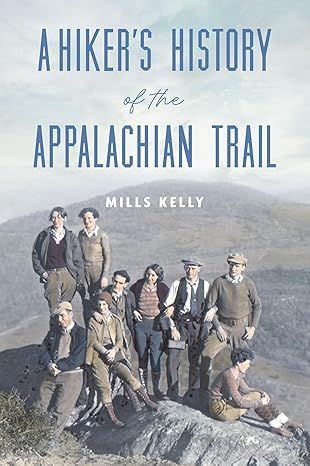
Thanks to Dan Hippe, SNP North District Hoodlum and Ridgerunner coordinator, for recommending Mills Kelly's new "A Hikers History of the Appalachian Trail.” Kelly is professor emeritus of history at George Mason University and no stranger to PATC. Along with serving as the club's volunteer archivist, he maintains the Manassas Gap shelter on the AT and is on the board of the AT Museum. His 50-episode podcast on the AT, "The Green Tunnel," helped many a homebound hiker maintain their sanity during the pandemic. It is still available online.
"A Hikers History of the Appalachian Trail" comes as the AT turn 100 and follows closely on the heels of Kelly’s "Virginia's Lost Appalachian Trail," which appeared in 2023 and deals with the trail’s relocation in southern Virginia in 1952. Kelly began writing "A Hikers History of the Appalachian Trail" in 2016. For some time, he had believed that most books on the AT with their focus on the trail's founders and builders, while valuable, neglected an important AT population--hikers. He was especially interested in non-thru hikers whose books abound. While he includes an entire chapter on thru-hikers, his main goal in writing "A Hikers History of the Appalachian Trail," was to tell the story of the AT from the bottom up and focus on the hikers that Benton MacKaye had in mind when he proposed the trail’s creation and actually are the majority of hikers on the AT: urban dwellers looking for a few hours or days in nature as an escape from the hurly burly of daily life.
Kelly himself grew up in the suburbs of Northern Virginia. His first AT experience was in the summer of 1971 with the Boy Scouts. It was a disaster on many levels. But he loved it. A year later, Ed Garvey, author of "Appalachian Hiker: Adventure of a Lifetime," spoke to his Boy Scout troop, and Kelly was hooked.
The main sources for "A Hikers History of the Appalachian Trail" were AT shelter logs, contemporary newspaper accounts and ads, and interviews. The book has a short but useful bibliography in the form of a future reading list. Kelly also references sources in the text. Readers are spared footnotes, and Kelly's style is conversational. His chapter on forest bathing and the appeal of nature borders on the lyrical. He includes a raft of contemporary photos, drawings, and advertisements dating back to the AT's creation in the 1920s.
Throughout the book, Kelly tries to strike a balance between readers new to the AT and those with a range of experience on the trail. Thus, despite his promise to look at the trail from the bottom up, he opens with a short chapter on the history of hiking in the US, the birth of the AT, and the trail's construction and use in its early pre-WWII days. Much of this will be familiar to those who have read works like Philip D'Anieri's "The Appalachian Trail: A Biography,” which Kelly includes in his suggested reading list. The chapters are a good introduction to both the trail and book, especially if paired with D'Anieri's. The cast of characters in these chapters includes Emerson, Thoreau and of course MacKaye and Myron Avery as well as organizations like the Appalachian Mountain Club, Sierra Club, and AT Conservancy. Kelly notes that current day hikers would hardly recognize the AT in its early years. A good deal of the trail was a patchwork of old farm and logging roads and footpaths. It was also not as generally wild as the current trail. Outside of New England, shelters or huts were rare. Hikers often hiked from one village to another and depended on the generosity of the locals for food and lodging and other early manifestations of trail magic. Organized group hikes tended to be the rule. For those who ventured out alone, hours even days could pass without seeing others. Thru hikers had yet to appear.
More experienced hikers will find later chapters to be trips down memory lane. In the one on gear, Kelly traces the evolution of packs from Trapper Nelsons to Kelty, Jansport and ultra-lite and the introduction of Vibram soled boots. The chapter on food is particularly fun because of its inclusion of grub lists from the 1920s and 1950 and ads for delicacies like Knorr’s Erbswurst and Dri-Lite.
Some may quibble with Kelly’s choices. When discussing outfitters, he includes LL Bean and even Duluth Trading Co. but makes no mention of REI, nor is there mention of Colin Fletcher’s classic “The Complete Walker.” Some of these omissions may be the result of Kelly’s reliance on the hiker entries in the shelter log books. In any case, he deserves high marks for a chapter on the AT’s history as a “bastion of whiteness.” Kelly also includes a chapter on shelters complete with a copy of the original 1938 plans for one but provides few details on trail maintenance beyond noting that it has fallen mainly to the various regional clubs that make up the ATC. This could be a good sign. We might get another book. We can always hope.
Have you come across a good read? If so, send it along to wplimberg@aol.com. Meanwhile, keep reading and hiking. See you on the trail.