
"What on Earth?"
Article and Photo by Ray Barbehenn
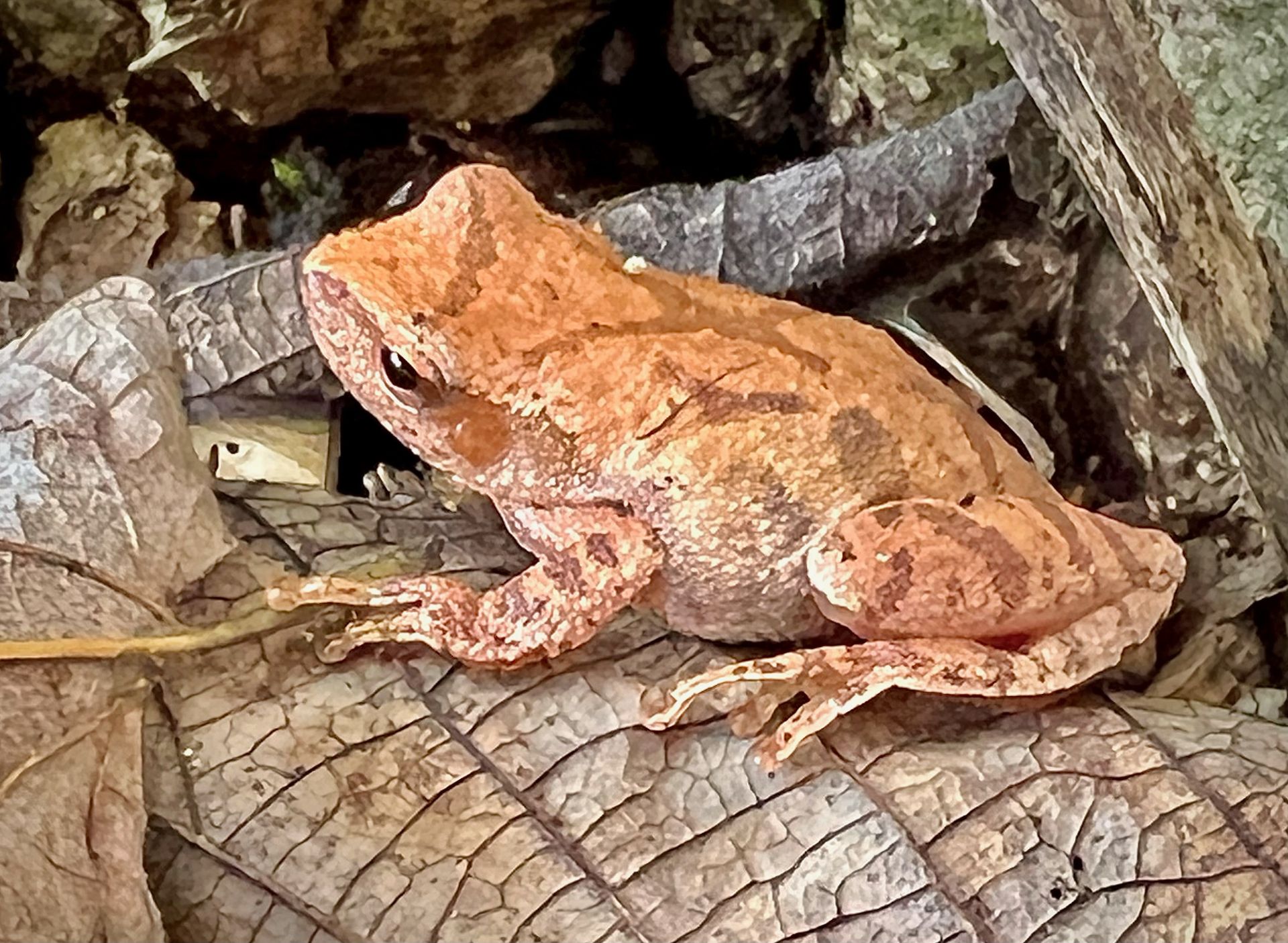
What on Earth?
Spring Peepers can sometimes be heard along the AT. Over time, they have made their way up into the hills along creeks – the lucky ones finding woodland ponds or marshy areas in which to breed. These frogs are only about an inch long, but they are loud. Even from 50 yards away, the combined racket of hundreds of calling males can warrant using ear plugs for those who camp nearby. However, try to sneak up for a peek at one, and they suddenly become silent and invisible; they watch closely for danger and are superbly camouflaged.
The Spring Peeper in the above photo was observed in the woods near the AT in Duke Hollow (northern Virginia) on September 24. Notice the bulbous tips of its toes. These are helpful for climbing and clinging to wet objects. Its excellent camouflage includes stripes on its legs, a distinctive brown stripe between its eyes, and an X-shaped pattern on its back. The X-shaped pattern inspired the Spring Peeper's Latin name,
Pseudacris crucifer, referring to the shape as a cross (as in "crucifix").
During much of the summer and fall, Spring Peepers are widely scattered in the moist woods. Instead of calling loudly together at their breeding area, individual males make occasional, softer peeps in the fall. And, instead of calling in the evening and night, they call during the day. Based on these different behaviors, they are sometimes called Fall Peepers. Their calls in the fall are a unique sound. To my knowledge, the other species in our area – the Pickerel Frogs, Bullfrogs, Green Frogs, Gray Tree Frogs, and Wood Frogs – remain silent after they finish breeding.
Why do Spring Peepers peep in the woods in the fall?
A. They moved to the woods to hunt, and their peeps help startle prey.
B. They moved to the woods to hunt, and peep in preparation for breeding in the spring.
C. They call in the woods to defend their hunting territories.
D. Unknown.
The answer is at the bottom of the page!
Fun Facts and Musings
Male Spring Peepers actually begin calling in the late winter, not long after the ice has melted from their breeding areas. Near the AT in Duke Hollow, this is during the first weeks in March. The males establish small territories of about a square yard at the edges of ponds or other wet areas, announcing their presence for one to three weeks before breeding begins. They mainly call at night, beginning in earnest just before sunset and often going until after midnight. However, each frog does not call for this entire time; though the racket may seem constant, each frog calls on and off for a total of about three hours. Calling at a rate of about one peep per second, each male makes over 10,000 loud peeps per night! These are tiny athletes. (Try yelling "peep!" once a second even for just one minute!) Not surprisingly, they have incredibly well-developed muscles for exhaling, known as the oblique or trunk muscles. Indeed, the energy expenditure of these little frog muscles is far higher than the muscles of any other "cold-blooded" vertebrate and is as high as that of highly active muscles in "warm-blooded" animals.
How do tiny Spring Peepers make such loud calls? They use not only their impressive trunk muscles to exhale forcefully, but also large "vocal sacs." When inflated, these balloon-like throat pouches may be almost as large as the frog's body! The vocal sacs help amplify their calls by resonating at the sound frequency of their peeps. The sacs also allow them to call more efficiently. As a Peeper peeps, some of its exhaled air inflates the sac further. As the sac relaxes, it forces air back into the lungs, quickly preparing the frog to make another call. You can see a Spring Peeper peeping in the following video:
https://www.youtube.com/shorts/H0NkA3xOOAk. Note how its trunk muscles and vocal sac work together, alternating their contractions.
Why do Peepers expend so much energy peeping? Like many displays of male prowess, peeping is mainly an effort to impress the females. Female Peepers choose which males are most attractive to them, and they appear to be more attracted to full-sized frogs that are able to keep up a higher calling rate and make louder calls. Males also peep to maintain a territory and will tussle with other males that get into their spaces.
The breeding period lasts about two months for Spring Peepers, after which they disperse into the forest for the rest of the year. Thus, they are really woodland frogs for most of their lives. And, even while they are breeding they venture back into the woods to hunt. After breeding, they move further away from water – often around 200 to 300 yards, and up to a maximum of about 1200 yards. In the woods, they presumably find a greater abundance of food, which includes a wide variety of insects and spiders.
As the weather grows cold, Spring Peepers seek shelter from freezing by digging themselves deeply into leaf litter or squeezing under rocks or logs. A few inches of good insulation makes a big difference in the underlying temperature. If you have ever scraped away the leaf litter or rolled over a log in the winter, you will probably have noticed moist soil, tender seedlings, or various unfrozen critters.
However, there are limits to how effective a hibernation spot is against freezing weather. Peepers must still be able to survive when their body temperatures go below 32 degrees. To do this, they make their own antifreeze! In a period of hours, they can boost the concentration of glucose (sugar) in their blood and organs by breaking down the stored glycogen in their livers. (We also store glycogen for energy in our livers.) As the concentration of glucose goes up by as much as 100-fold in their bodies, the water in their bodies does not freeze until it is well below 32 degrees. This is the same phenomenon that we make use of when salting icy roads or adding ethylene glycol to our car radiators.
So, why do some Spring Peepers begin to call again in the fall when they aren't breeding? It isn't clear (answer D). Some frog biologists have speculated that the males may be excited by a surge of hormones as they mature their sperm in the summer, presumably to be prepared for early spring breeding (answer B). They may also be excited by the weather and daylength in the fall, both of which can be similar to late winter when they breed. However, it is important to note that only a small number of Peepers call in the fall. If they are excited, then why is there is no noisy chorus in the fall as the males go through frog puberty? Perhaps Fall Peepers are young males learning to peep (answer B)? (They do make weak calls and only repeat them for a few minutes.) Or, perhaps males in the woods peep occasionally to defend their hunting territories (answer C). Thus, fall peeping remains a peculiar and poorly understood phenomenon. Fall Peepers are another example of the many, many aspects of nature that remain virtually unexplored.
Answer: D! (or B?)
Send your photos and ideas for topics to Ray at rvb@umich.edu. Wanted: Photos of opossums, foxes, coyotes, and anything else that you have a good picture of!
<<Previous Article Back Home Next Article>>