
Southern Shenandoah Valley Chapter Unblocks the Carr Mountain Trail
By Paul Boisen
On a terribly cold morning in December 2025 on the Great Eastern Trail (GET) just south of Bergton, VA, Lavern Beachy (trail name GETe Farmer (‘e’ for ‘enthusiast’)) woke up and decided that he had had enough of this particular December! He packed his tent, put on every stitch of clothing he had, and started walking south at 5 A.M. In a few minutes he was warm, and in an hour he had cell service. He contacted Jim Fye, who had made a standing offer of extraction, and then walked 18 miles south to the pickup point.
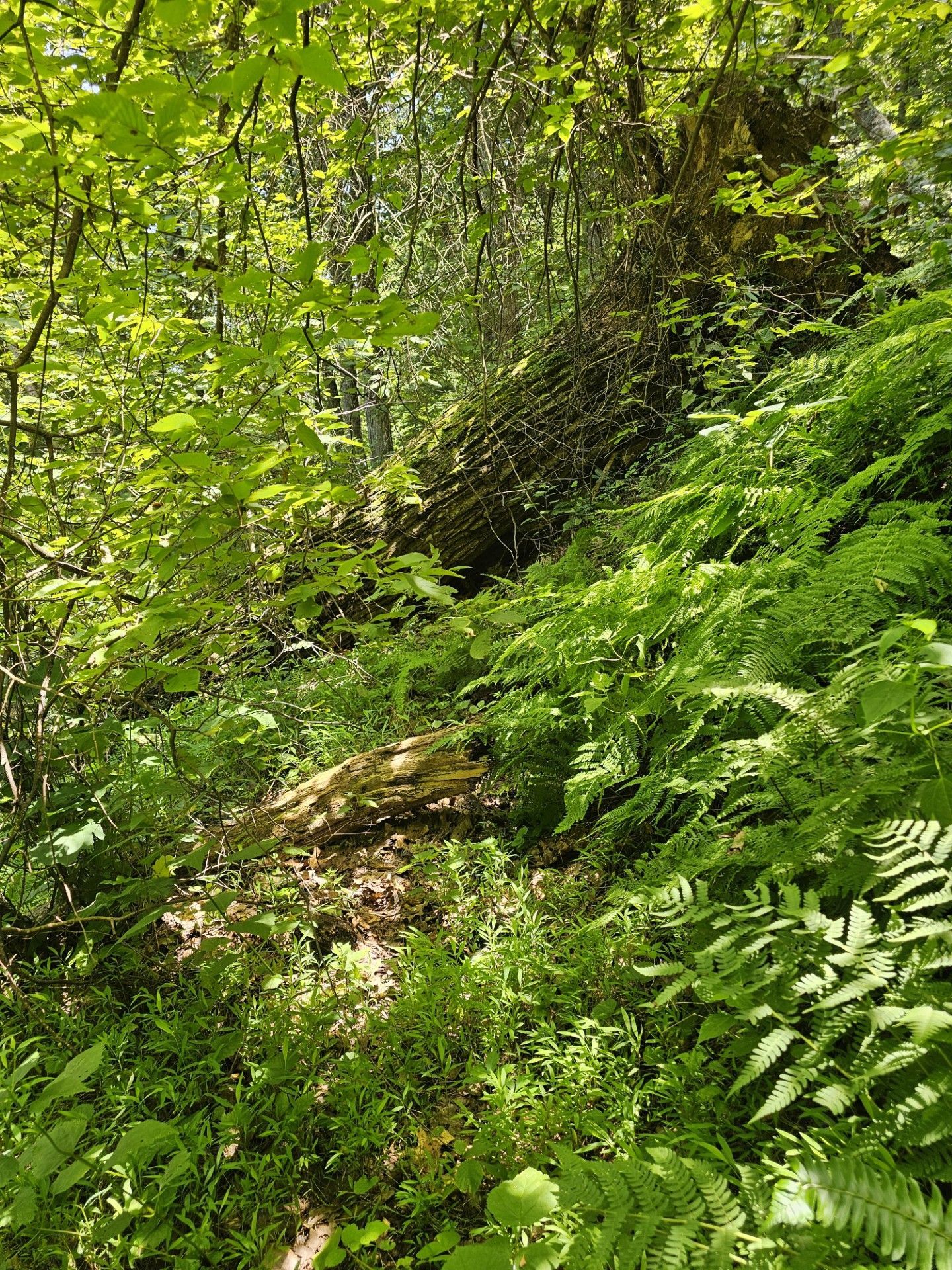
That 18-mile walk started with the Carr Mountain Trail, which turned out to be one obstacle after another: branches down everywhere, a 30" blowdown to scramble over, multiple downed tree canopies that had to be circumvented, faded blazes, and dense patches of bramble colonizing the tread. This was disappointing, as the Southern Shenandoah Valley Chapter (SSVC) of PATC had constructed the Carr Mountain Trail during April 2009 to April 2015, and it was officially part of the GET. GET is an 1800-mile path connecting Alabama to the Finger Lakes trail in New York ( https://www.greateasterntrail.net ). The 6-mile Carr Mountain Trail was built to connect Church Mountain with Shenandoah Mountain.
Jim and GETe Farmer met on highway 33 at the High Knob trailhead, and began a conversation about what could be done to improve the trail. By April the SSVC was advertising a July multi-day work trip on the Carr Mountain Trail. At the request of SSVC, the George Washington National Forest North River District cleared the majority of the 6-mile forest road to the trailhead. Fye, Beachy and Paul Boisen made two additional preparatory trips in June and July to clear blowdowns off the last mile of forest road. They also weed-whacked a small meadow near the trailhead for use as a campsite, and discovered a horse trail, a pond, and a fire ring. The last blowdown before the meadow was made into firewood.
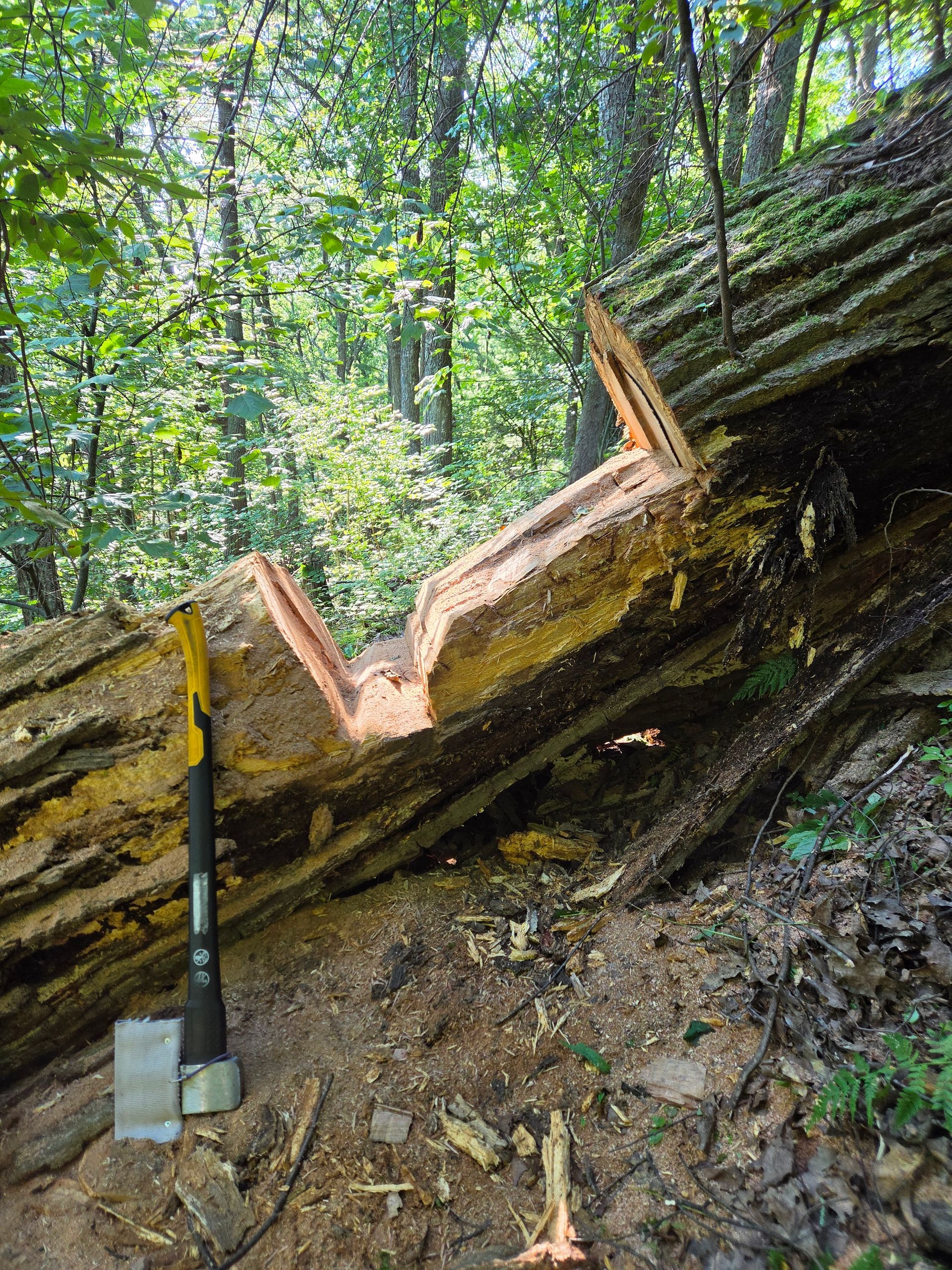
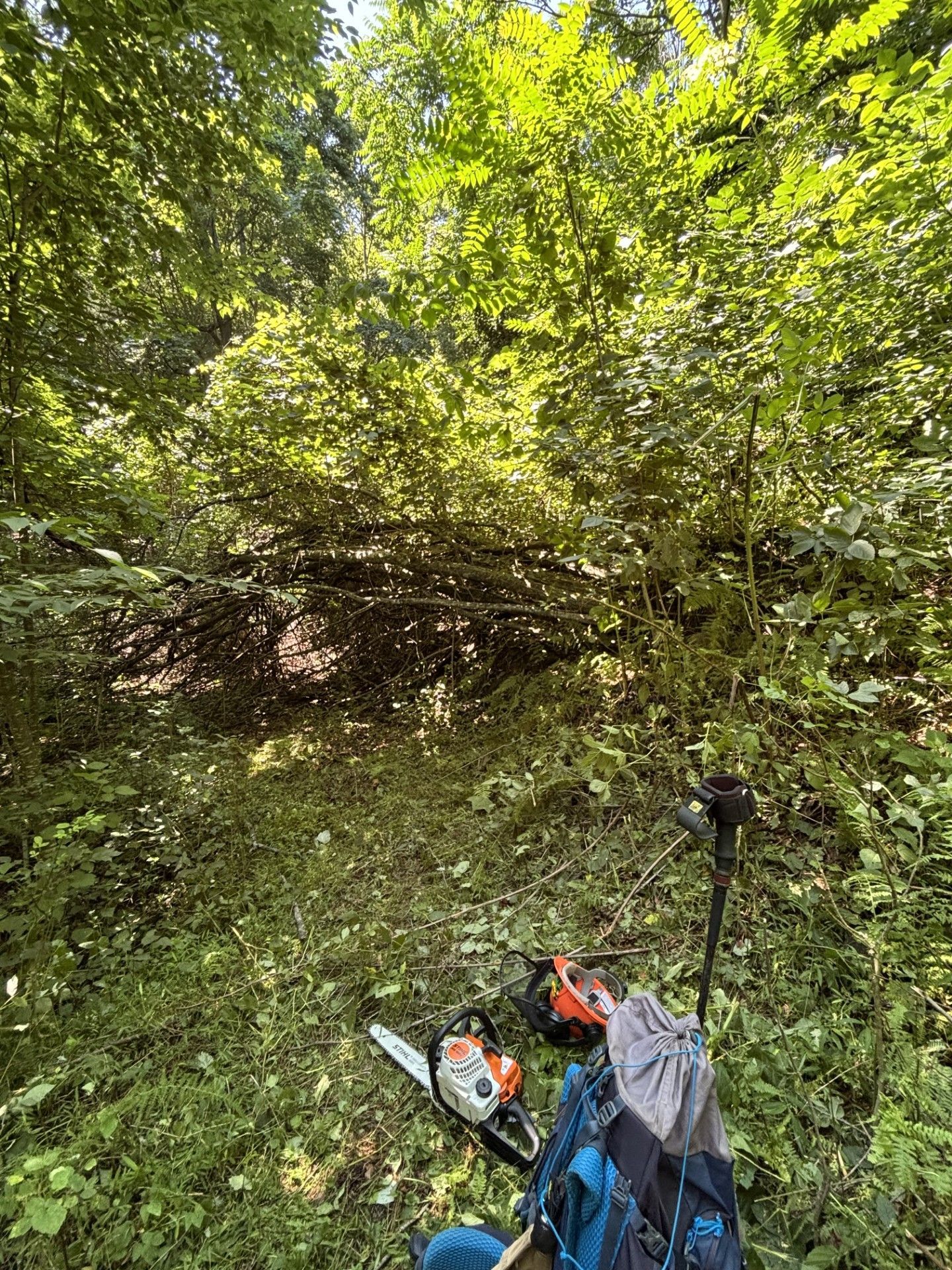
On Monday, July 13, four people in two pickup trucks made the bumpy 6-mile trip from the Bergton Blue Hole up 1400 vertical feet to the meadow. They set up tents and walked to the Carr Mountain Trail. Lavern Beachy went first with a weed-whacker, determined to clear tall grass and brambles off three miles of trail. He had to scramble around obstacles again, just as he did in December, but the result was that the three following sawyers (Larry Ragland, Jim Fye, Paul Boisen) had easy tick-free access to those obstacles. On this first day, Lavern weed-whacked two miles of trail, and Larry Ragland cut a step into a 30" tree trunk using a 16" chainsaw (actually severing the trunk was not advisable, as the uphill rootball was not stable).
That evening the group convened in the meadow for supper at a portable picnic table and shelter provided by organizer Jim Fye. Later there was a campfire, and an impressive display of stars in the clear sky. Frogs from the nearby pond sang the group to sleep, and Whippoorwills woke them in the morning.
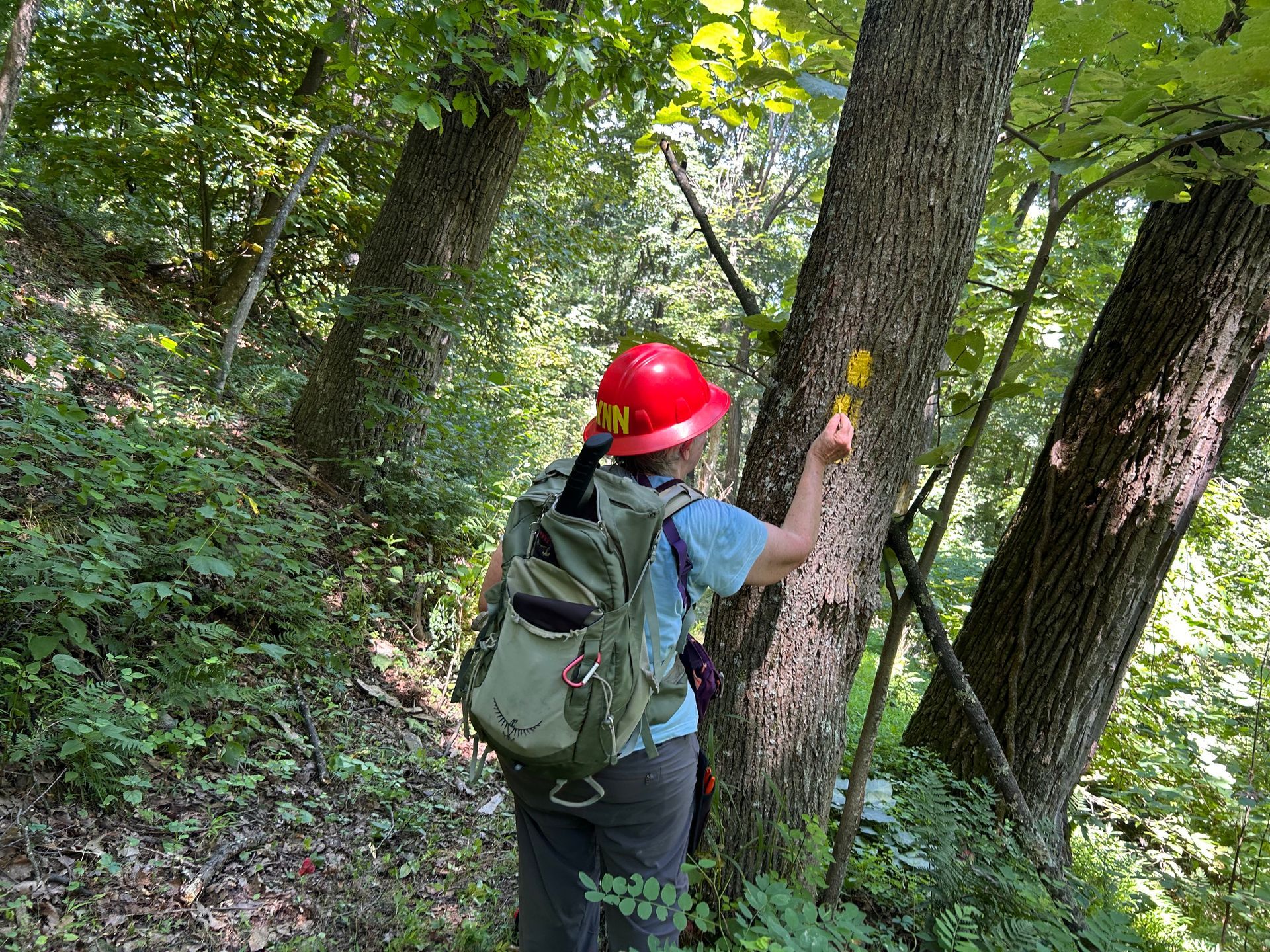
Tuesday began similarly, with Lavern shooting out of camp early as if the brambles were running away. Jim and Paul followed with hand saws, along with Larry and his chainsaw. They dropped a one-gallon water cache about a mile from camp, since the day was hot and they knew that four more people (Lynn and Malcolm Cameron, Tim Hupp, and Ron Stoltzfus) were due to arrive as the day heated up. The Day-Two Crew concentrated on the first 1.5 miles of trail, clearing smaller downs left by the saw crew, clipping, removing debris from the trail and painting yellow blazes. Tim Hupp, Great Eastern Trail Association President, caught up with Paul and Larry working on a trio of downed trees, then continued working further up the mountain trail to eventually speak with Jim and Lavern.
In the early afternoon all eight workers convened in the meadow to pack up camp and start driving down the mountain. An hour later they arrived at the Bergton Blue Hole, where Paul's wife Krisztina Székely provided a meal of Hungarian Gulyás (beef stew) with Meggyes Piskóta (cherry sponge cake). Comparing notes, we learned that the weed-whacking extended 3.5 miles up the trail, and the sawyers had cleared to 2.5 miles. The other half of the trail is not as badly conditioned as the first half was, and we expect to have an easier time on the follow-up trip starting at the remote trailhead. Future GET hikers will have a much easier time due to SSVC’s efforts.
<<Previous Article Back Home Next Article>>