
President's Logbook
By Jim Fetig
The first thing I see when Microsoft Word opens is a question. What would I like Co-pilot to draft?
What! While there may be some administrative areas where AI can be helpful to the club, I doubt we’re in much danger.
AI might be able to help plan a hike, but it can’t lead one. It can’t build a waterbar, start a chainsaw, or repair a cabin roof. Of note, business is booming for the Crapper Crew. As an organization, as volunteers, as people who love the outdoors, we can feel confident that we will be busy.
As we melt into mid-summer, the administrative load lightens while our outdoor activity load and the temperature picks up. Seems like almost everybody is out and about.
At the moment, I’m preparing for crew week in Shenandoah where we work hand in glove with the park service crew. It’s an opportunity to learn, bond, and share the load. It’s a decades-long best practice.
Each time I enter the park, I’m struck by its founding story. Much of it is ugly. Families were displaced from their farms and livelihoods after a nasty propaganda campaign designed to denigrate those whose land would be taken at rock bottom prices by eminent domain.
I am quick to note that we work with park employees whose family names denote terrain features throughout the park. Some still lovingly tend family cemetery plots scattered throughout the park.
The July 1937 PATC “Bulletin” (now the Potomac Appalachian) tells another part of the founding story. It speaks to how the current location was selected over Massanutten. You can read the full article below.
When I talk to new members about volunteering, I always mention the friendships, the community of common interest, and the fun we have, be it leading a hike, building a new porch on Mutton Top, or in my case, working with the posse which helps maintain the AT section for which Nicole Bridgland and I are responsible.
Our posse includes people with whom I worked 30 years ago, a former ridgerunner, and others who share a love for the outdoors with whom I’ve crossed paths. Some come frequently while others come when they can. We’re almost a mini trail crew.
Unfortunately, norovirus is present in our area. The first case was reported at Black Rock Hut in the South District of Shenandoah. The Conservancy and NPS are keeping track. This is not our first rodeo with norovirus. Our crews are disinfecting sites where we have confirmed incidents. The ridgerunners disinfect the privys as part of their normal duties. Stay safe, wash your hands with soap and keep your hands away from your face as you hike this summer.
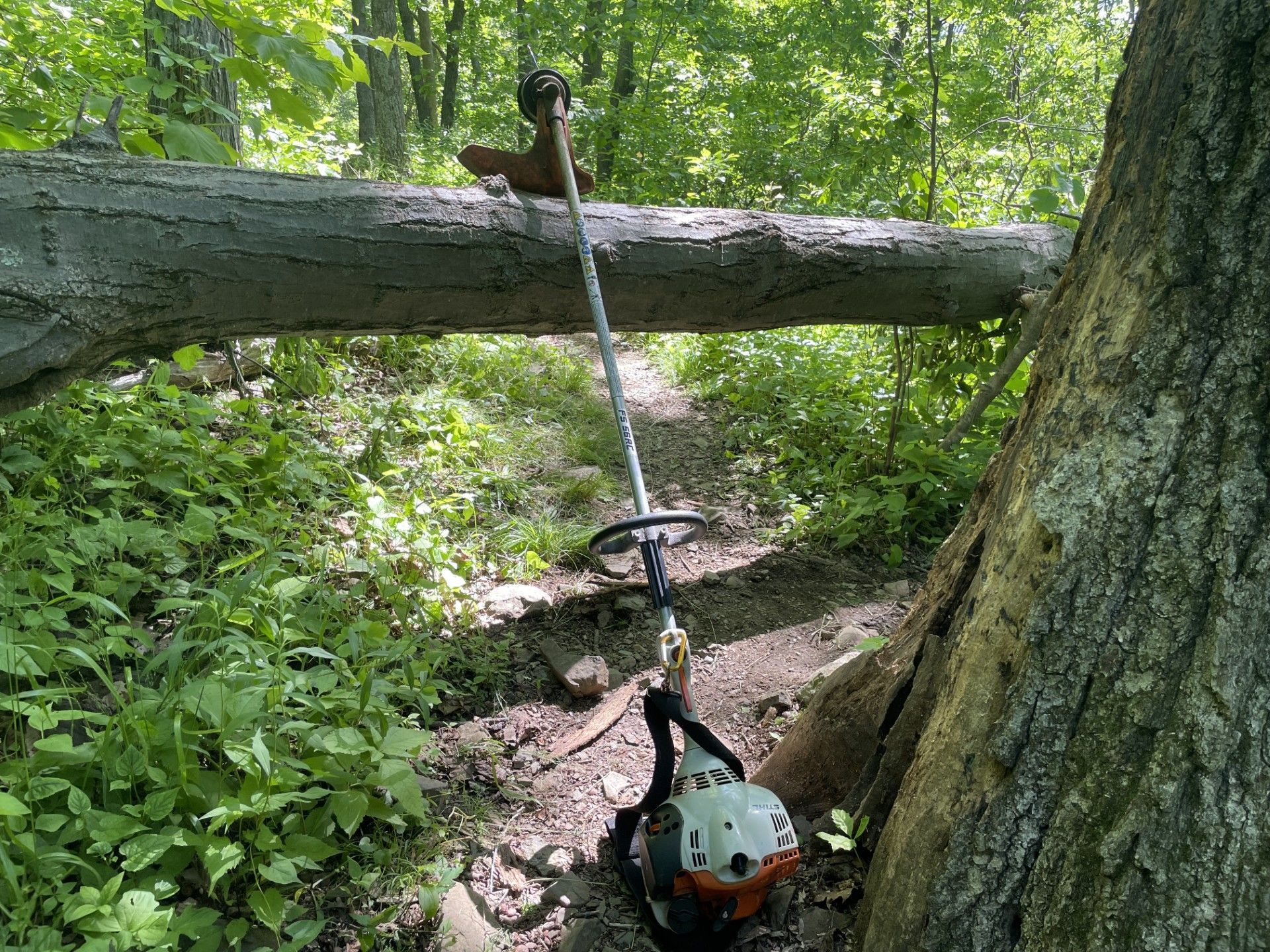
Me, I’ll be out checking my waterbars for tenure. Those that aren’t tenured will probably be replaced by grade dips. As for the weeds, don’t get too confident. We’re coming for you.
BEGINNINGS OF SHENANDOAH NATIONAL PARK By G. Freeman Pollock
The Blue Ridge land I acquired through my father had appealed to him from the standpoint of its natural resources; but instead of profiting from these I preferred to enjoy the natural attractions of the place, which I was in love with from the beginning. This is probably the only kind of exploitation that preserves and protects instead of marring and destroying natural beauty, and since the first suggestion of a national park in the Blue Ridge was inspired by the state of nature at Skyland, and the suggestion was first "sold" to the site selection commission there, I think it can truthfully be said that the existence of Shenandoah National Park and the Skyline Drive today is due to my adherence to the fortunate decision I made thirty-five years ago.
Our good friends Mr. and Mrs. Harold Allen of Washington, D. C.. had visited Skyland several times and were so enthusiastic over its scenery that they only regretted it was not more widely known and enjoyed. In February, 1924 came a small Washington Star clipping by mail from Mr. Allen, with "Why not Skyland?" on a slip of paper attached. The clipping told of the appointment by Secretary of the Interior Work of a special commission to recommend the site for a national park in the Southern Appalachians. I was very busy, and nothing came of the matter until early in the summer when the Allens came to Skyland, but Harold Allen had kept it in mind and before he left Washington, interviewed Colonel Glenn H. Smith, Secretary of the Commission, learned the status of the undertaking, and obtained a copy of the Government's printed questionnaire, which he brought with him to Skyland.
The commission had been approached by a number of individuals and groups suggesting various sites, all unsuitable for park purposes for one reason or another; the time for their report was nearly up, and the commission was pretty well satisfied that no acceptable site was available north of the Great Smoky Mountains. It appeared that the Massanutten Mountain area had been sug- gested to the Commission, but was not believed to be up to National Park standard. The questionnaire, which Harold Allen urged be filled in at once, was a challenge which he pointed out the Skyland region could meet; and with the benefit of his information received from Colonel Smith, he and I went into confab next morning with Mr. George H. Judd in that famous session in the Judd "Tryst of the Winds," and dictated to my stenographer a rough draft of the information pertaining to the Skyland region which the Government wanted about proposed sites.
I personally answered most of the questions as I was the only one sufficiently familiar with the area to do so. I said frankly that I was familiar with about 50,000 acres surrounding Skyland and felt sure that territory both north and south of this area could be quickly explored and undoubtedly would be found to be of the same caliber. I proposed to explore those areas at my own expense and make a further report. The answers sounded good. They actually were. We all got excited with the task as it progressed. And no wonder! Just to recount the natural features f the region convinced us that we had a real national park site to present, and were perhaps making history that very moment in doing so. The time limit was so nearly up that Harold Allen left with the precious papers forthwith for Washington, where he condensed the rough draft, had the questionnaire typed up and, not trusting the United States mail, handed it himself to Colonel Smith with an earnest statement to the effect that "This has been prepared by responsible people who know the facts they present, It is all true. When you have read it you will see that it will be impossible for the commission not to come and inspect the Skyland region." This last statement also turned out to be true, but not without some further oral persuasion.
A few days later I read in a Winchester paper an article by the Honorable Thomas W. Harrison of Front Royal, Va., Member of Congress, describing the Massanutten erea and stating that an organization known as Shenandoah Valley, Inc., was promoting that site and seeking to have the commission recommend it as suitable for a national park. I got in touch with Harold Allen and we studied this article and agreed that these people were working on the wrong track and that Virginia should get behind something much finer than the Massanutten project. We made an appointment with Mr. Hugh Naylor of Front Royal, who was at the head of Shenandoah Valley, Inc., promoters of the Massanutten site, to show us the points of interest in it. A few days later Mr. and Mrs. Allen, Mr. and Mrs. Ferdinand Zerkel of Luray, Mrs. Pollock and I met Mr. Naylor and were taken to see what this area offered. We drove into the Fort Valley from Front Royal and came out at Strasburg. Even in this brief excursion it was obvious that comparison with the Blue Ridge was absurd, and we also quickly saw that there was no chance for this area being considered seriously by the commission.
Knowing that Ferdinand Zerkel was an important member of Shenandoah Valley, Ine., I made an appointment with him to meet me at the Page Valley National Bank in Luray on a matter of great importance. He met me and in the presence of Mr. Emmit Berry, cashier of the bank, I talked for an hour like a wild man. The point was that with their organization already set up, this was a fine opportunity for them to take up the Blue Ridge proposition and drop the Massanutten at once. I explained that the park finding commission could see without walking out of Colonel Glenn Smith's office, by examining topographic maps, that the Massanutten area offered no attractions for a national park. Mr. Berry and Mr. Zerkel could not help being impressed with my argument, but the organization waя already definitely committed to the Massanutten area. Action had to be quick as the commission had just about finished its visits and nothing acceptable north of the Great Smokies had been seen.
I clinched my argument with, "Why continue, only because you are committed to it, advocating something which you know to be a foredoomed failure? Why not get on the band wagon with a movement that promises to be a success?" This seemed to strike the nail on the head and when I asked Mr. Zerkel where I could get in touch with Shenandoah Valley, Inc., and he replied, "At Harrisonburg." I shouted. "Let's call them up. Let me talk to them." Mr. Dan Wine, Secretary of Shenandoah Valley, Ine., was quickly reached and I told him that I had some information relative to the national park situation of such immediate importance that I would like to have him call a meeting of as many of the members of his organization as could be gathered together while I was driving from Luray to Harrisonburg. "O. K. Come along," was Dan Wine's answer.
So Ferdinand Zerkel and I made the trip. There were some twelve or fifteen members of Shenandoah Valley, Inc., at the meeting. Ignoring formality, I laid the facts on the table, cold and hard. "You are betting on a lame horse. You haven't got a chance in a million. You are working in a lost cause. I know what I am talking about-my home in the Blue Ridge is 1200 feet higher than the highest peak in Massanutten, and is surrounded by wonderful scenery with towering peaks and sheer cliffs. Close to Skyland lie hidden stands of virgin timber." So I talked on. I wish I had a phonograph record now of that talk, for it must have been rousing. I was all "het up." Of course they showed immediate interest. When I urged that a group of them visit Skyland without delay and convince themselves of the facts I had stated, they accepted and a few days later a group arrived and were taken around. They were frankly surprised and impressed, but up to this point they had no idea of giving up advocacy of the Massanutten site, and a debate was proposed.
This took place at Dan Wine's mountain home at Rawley Springs. Hugh Naylor advocated the Massanutten area and I advocated the Blue Ridge. Ferdinand Zerkel supported me. At the finish Brother Naylor lacked a single leg to stand on, but this was no credit to us because it was only a case of facts. The Massanutten region contains lovely bits of scenery, but it is low in altitude and restricted in extent, and just not up to national park standard. Then again the national parks are under the control of the Department of the Interior, and the Massanutten area was already embraced in a national forest under the jurisdiction of the Department of Agriculture. That in itself would have been enough to eliminate it, as we later learned. The campaign had become a three-man "drive," the Washington end of which was handled by Messrs. Allen and Judd, the former even returning to his office at night to conduct the considerable correspondence that quickly sprang up. This has already been preserved and even now makes exciting reading. Mr. Allen again interviewed Colonel Smith and urged that the commission visit the Skyland area, but without obtaining a definite promise that they would. None of the members knew the Blue Ridge at all and they did not feel that there could be enough there to warrant a visit of inspection. There simply could not be anything worth while short of the Smokies.
At this point I fortified myself with letters of endorsement from influential people familiar with the Skyland rerion, and went to Washington. Taking with me Major General Merritt O. Ireland, then Surgeon General of the United States Army, who had long been an enthusiastic patron of Skyland, we landed in Colonel Smiths office. There I talked loud and long. Colonel Smith told me that Mrs. Smith had once spent two days at my place and he knew that it was beautiful, but that the commission did not feel that it could come up to the requirements of a national park: it seemed imnossible that such an area could exist so near the capital. However, I was so persistent that Colonel Smith said finally that he would see what the commission might do. I immediately invited any or all of them to come as my personal guests. A few days later I received at Skyland a telegram from Colonel Smith, informing me he and Major Welch of the commission would arrive at Luray on a given date. I quickly informed officers of Shenandoah Valley. Inc., of the good news.
By this time I believe most of them were fully convinced that we were on the right track, but as an organization they were still committed to the Massanutten site. This was the first public indication of what had been done by Allen, Pollock and Judd toward attracting attention to the Skyland area for park purposes. It occurred on September 12, 1924, and the report made by the commission after the inspection, which became an official document, contains the following: "Major Welch and Colonel Smith left that evening for Luray to inspect an area lying in the Blue Ridge, extending from Front Royal to Waynesboro. On arrival at Luray they were met by several hundred residents headed by a band. It developed that two delegations were present, one representing those interested in recommending the Massanutten Mountains as an area to be considered, and the other, headed by George Freeman Pollock, of Skyland, recommending the inspection of the Blue Ridge area. The committee members decided to go immediately to Skyland to make the inspection of that area first.
The delegation from the Massanutten Mountain area was invited by Mr. Pollock to accompany the Blue Ridge delegation, and the invitation was accepted.... After this short inspection Colonel Smith and Major Welch were so favorably impressed with the area that they decided to postpone further investigation until arrangements could be made for the whole committee to visit it.... The delegation recommending the Massanutten Mountains area, after this visit, were convinced that the area surrounding Skyland was superior to the Massanutten area; therefore the committee made no investigation of Massanutten at that time." Ferdinand Zerkel of Luray had long been whole-heartedly converted to the Blue Ridge area, of which he quickly became one of the most sincere and forceful supporters. He did yeoman service among his fellow members in Shenandoah Valley, Inc., and among citizens of Luray almost from the first, and became one of the most valuable workers in the plan, with remarkable devotion of his personal time, effort and money. He organized the Luray greeting and accompanied the party to Skyland, where it can truthfully be said that the visitors, including many from the valley who had never been on the Ridge, were greatly surprised and impressed by the wonders unfolded to them.
After this inspection, which was continued on horseback by the commission members for several days-the entire group being entertained throughout as my guests Shenandoah Valley, Inc., officially abandoned the Massanutten project, thus bringing with its full support a wealth of devoted enthusiasm and service to the enterprise, the value of which can scarcely be overestimated. Immediately following the inspection Ferdinand Zerkel assisted in gathering together a large group of prominent residents of Luray in the parlor of the Mansion Inn, where I gave an informal lecture or talk, imparting as much information as we had at that time, as to what a national park in the immediate vicinity would mean to local interests and to the State of Virginia.
The study and preparation of data for this talk had been dug out by Harold Allen in Washington, and we had all picked up much from the newspaper clippings when the commission was visiting North Carolina and Tennessee, so that I was pretty well equipped to give accurate and interesting information. This meeting was also attended by Dan Wine and others from Harrisonburg and Hugh Naylor from Front Royal. It was decided at this meeting to organize an association to be called the Northern Virginia Park Association, the object of which should be to bring about the recommendation of the Blue Ridge Mountain area around Skyland as a Southern Appalachian National Park.
This meeting really started the ball rolling. I was elected president; George H. Judd, of thWashington firm of Judd & Detweiler, printers of the National Geographic Magazine, (Mr. Judd having influence in Washington and having long been a cottage owner at Skyland), was elected first vice president; Harold Allen was elected second vice president; Dan Wine was elected secretary; L. Ferdinand Zerkel was elected chairman of the Board of Directors. We thereupon selected a number of prominent citizens, mostly of Virginia but a few from Washington, wrote them immediately asking if they would act on the Board of Directors, and received affirmative replies. These letters were all written from Skyland. prepared a little 15-page Immediately Mr. Allen in Washington brochure entitled, "A National Park near the Nation's Capital," 5,000 of which were nicely printed through the generosity of Mr. Judd. These booklets, the first informative bulletin sent out, got into the mails about November 17, 1924, addressed to chambers of commerce, state officers, Members of Congress, prominent citizens, intluential organizations in Virginia, newspapers, postmasters, Rotary and Kiwanis Clubs.They told briefly of the park movement and the Government's national park policy, narrated the Northern Virginia Park Association's genesis and objective, and set forth in full the Government questionnaire, with our answers. It stated forcefully what this tract would mean to the nation, and finally what it would mean to Virginia.
I think that nothing has been published even now that gives as much information, certainly not any more information, on the Shenandoah National Park. Our task was to inform and educate the people of the State on this park project, which was an entirely new one, outside the range of anyone's experience. At the same time that we were doing this, Shenandoah Valley, Inc., were working energetically along the same lines. The project aroused interest and received increasing support from various sections of the state. It was not known at that time that Virginia would have to buy the land. We had not been informed, but took it for granted that the United States Government would purchase the land selected for a national park.
Propaganda went out constantly. I had hired two stenographers at Skyland and for three months carried on busily, making the promotion of the park project Skyland's first business; taking care of its guests became secondary. The best photographs ever taken around Skyland were those of Mr. C. J. Hepburn of Philadelphia, during his residence there. Shenandoah Valley, Inc. later employed a Harrisonburg, Virginia, photographer to cover the area. The Norfolk & Western Railroad also sent expert photographers to Skyland. Uncertain weather conditions often required several horseback trips to get just what was wanted. The pictures they obtained were very fine and I have a large collection of prints from them. I think, however, that the Hepburn photographs have never been surpassed.
Later, when Congress was considering the bill for a survey of the proposed park, I established headquarters at the Willard Hotel, where I kept "open house" for some time, trying to make myself generally useful in interviewing Congressmen and showing them photographs of typical scenery, as well as appearing before the Committee on Public Lands for the same purpose. The principal proponents of park legislation before the Committee were Major Welch, chairman of the site-finding committee, and Colonel Glenn H. Smith, its secretary, but we had enthusiastic interest stirred up in Virginia by that time and quite a delegation of native sons on hand to help the cause.