"What on Earth?"
Article and Photos by Ray Barbehenn
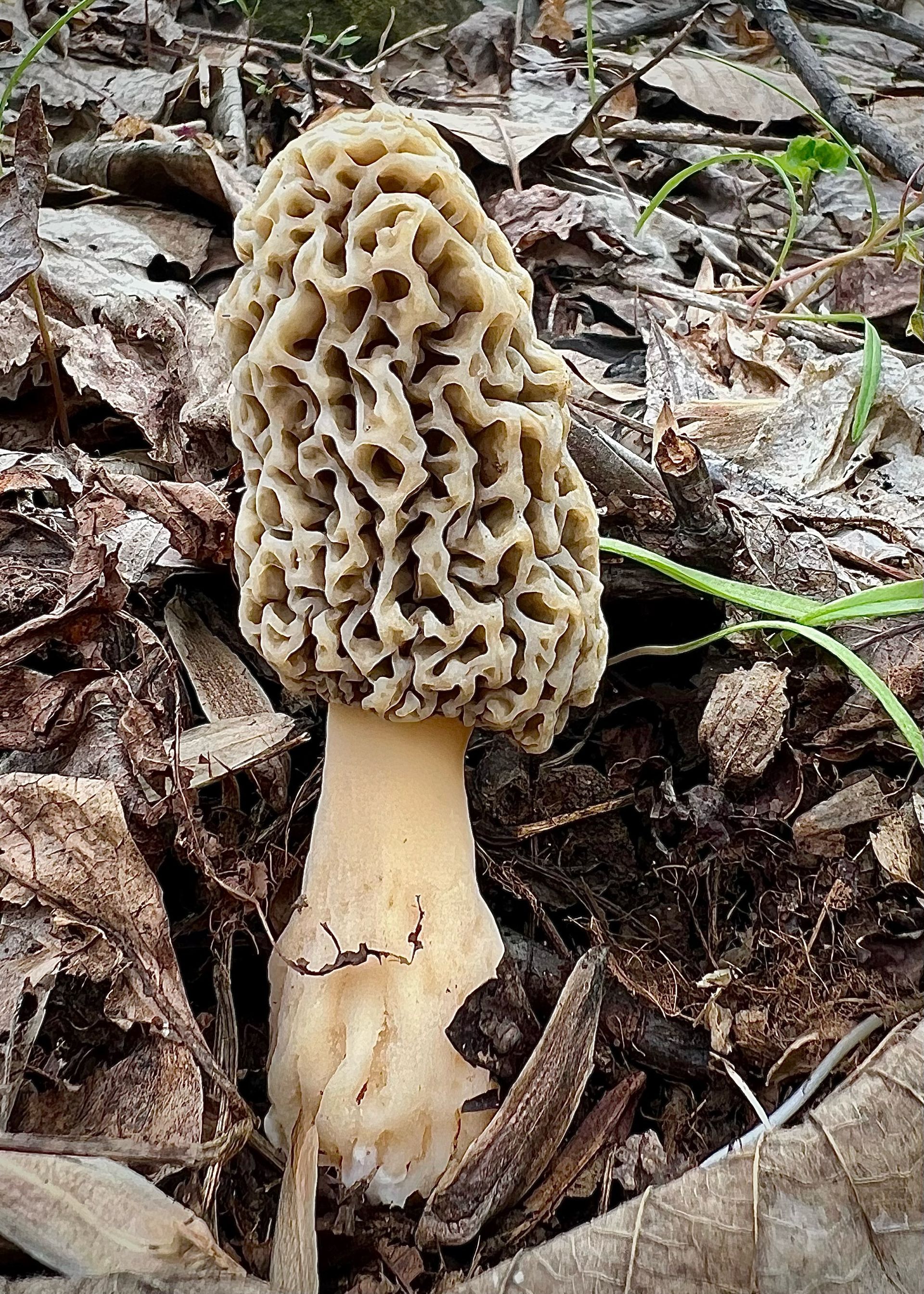
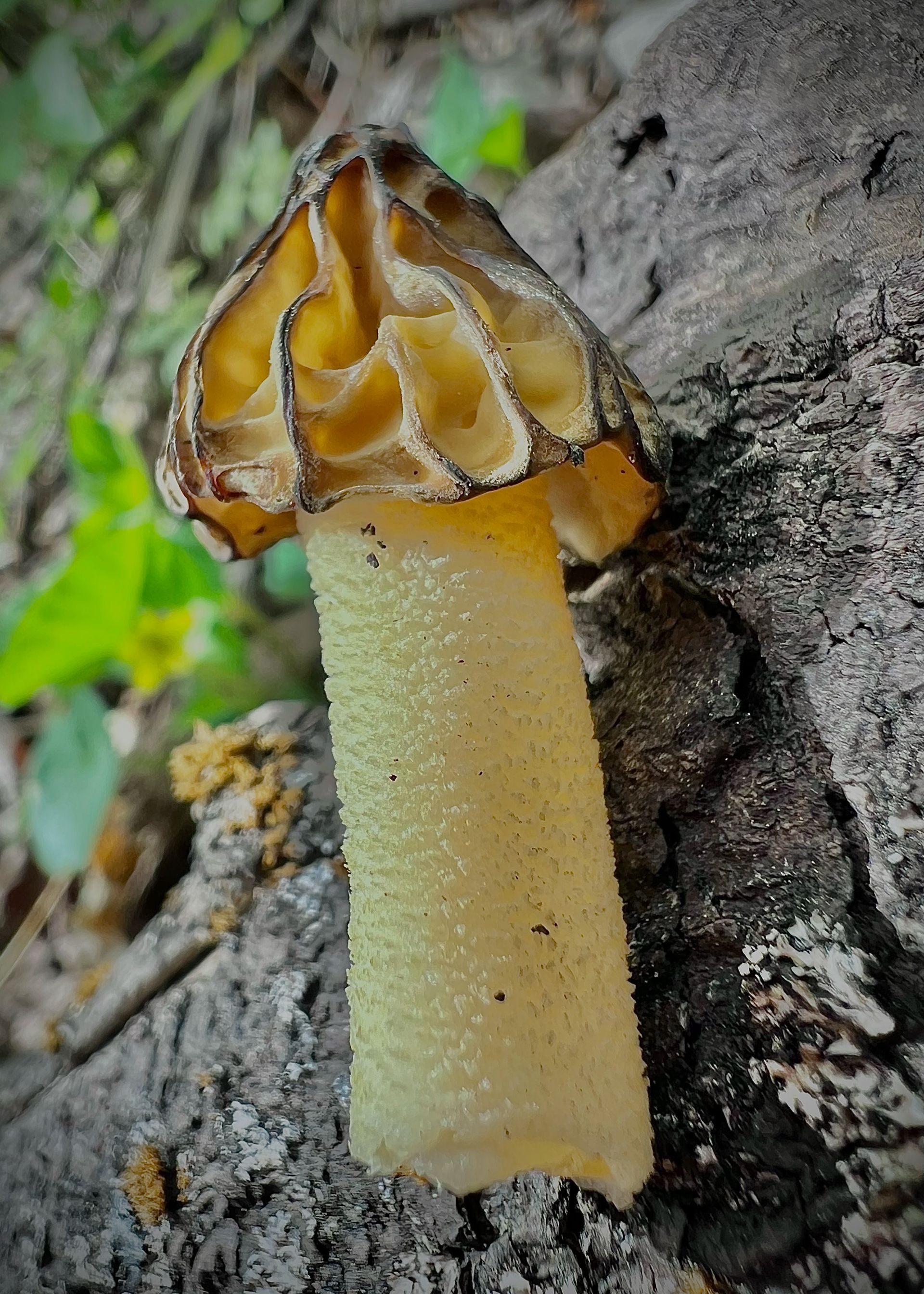
If you love the taste of mushrooms but have never tried morels, you might be in for a treat. It is legal to collect mushrooms along the AT corridor if you stay over 200 feet away from the trail. Up to a pound of mushrooms may be collected per day per person for personal consumption. (You should be so lucky!) Of course, you have to love bushwacking to find them. However, morels come up before the leaves are out, which makes the search easier.
Two kinds of morels found in our area are the American Yellow Morel (left photo) and the Half-free Morel (right photo). Both were found in Duke Hollow (near the AT in northern Virginia) on April 22, 2025. This is prime time for morel foraging. The American Yellow Morel was about three inches tall, but they range from about two to eight inches tall. By comparison, Half-free Morels are often small and thin; the one pictured above was about the size of your little finger. Notice the gap between the base of the cap and the stem. Beneath this skirt-like edge of the cap, it is attached half way up the stem. By comparison, the base of the cap of the American Yellow Morel is attached at the stem.
Are all morels edible?
A. Yes, but only after cooking.
B. No – one species is not.
C. Usually, but it depends on the person eating them.
The answer is at the bottom of the article!
Fun Facts and Musings
Why do morels look so strange compared to other mushrooms? Morels and gilled mushrooms are in different groups of fungi that are extremely distantly related; they may have split apart from their shared ancestors between 400-500 million years ago! The way that the mushrooms in these two groups of fungi make their spores is fundamentally different. Morels make their spores all over the surfaces of the cup-shaped pits in their caps. Their spores are lined up in microscopic tubes like peas in a pod, and they shoot out their spores like little pea shooters when the wind (or your breath!) passes over them. By comparison, the gills of gilled mushrooms are covered with what look like microscopic clubs, each of which has four spores arranged like a crown on its tip. Comparing such different fungi is like comparing fishes to lizards, which also split apart from their shared ancestors around 400 million years ago.
In our area, there are at least four species that you might find: the American Yellow Morel (Morchella americana), the Tulip Morel (Morchella diminutiva), the Half-free Morel (Morchella punctipes), and the Black Morel (Morchella angusticeps). The so-called "Gray Morel" is not recognized as a species; these are probably young American Yellow Morels. Adding to this confusion, the Black Morel is not necessarily black; the cap can range from shades of brown to black.
The tremendous variation in color, shape, and size within morel species continues to be a challenge for taxonomists and morel hunters alike. Some of the newly discovered species can only be identified from their DNA; they can look identical to other species.
False morels (Gyromitra species) are the most dangerous of the morel look-alikes; like true morels, they have twisted, misshapen caps but, unlike true morels, their stems are not hollow. To my eyes, their caps look like crumpled balls of paper. Would-be morel hunters should look up images of false morels to learn to avoid them. Unlike true morels, false morels are not made safe by cooking. The toxins in small amounts of false morels can produce serious gastrointestinal symptoms, but may cause dizziness, liver failure, and even death if larger amounts are eaten.
A competent morel hunter should also know the "Early Morel" or "Thimble-cap" (Verpa bohemica). This is not a true morel but it looks very similar to the Half-free Morel. However, when sliced in half, you can see that its cap is attached at the very top of the stem like a "normal" mushroom, and it has a cottony substance inside its stem. Descriptions of its edibility are mixed, ranging from "edible with caution" to "causes severe gastrointestinal upset and cerebellar syndrome in susceptible individuals."
A good morel key with photos is found athttps://www.mushroomexpert.com/morchellaceae.html. The beautiful diversity of morels around the world can be seen at
https://www.inaturalist.org/observations?subview=map&taxon_id=56831&view=species. At this site, you can also see photos of the tremendous variation in the size and color of various morel species.
Morels, like many species of mushrooms, often form symbiotic associations with the roots of certain species of trees. This makes it advantageous to forage in areas where these trees are prominent. One of the sad impacts of losing our White Ashes to Emerald Ash Borers and many elms to Dutch Elm Disease is that these were some of the morels' favorite partners. There are still dying elms around, and these are good places to hunt morels. Other partner trees for certain morel species include Tulip Trees and hickories, both of which are still common.
Won't picking morels hurt their populations? Harvesting some of the morels each year should be relatively harmless to these fungi. The mushroom is just a short-lived spore-producing structure. The bulk of the fungus lives protected underground as a network of fine rootlike structures. And, a single unpicked mushroom may let loose a billion spores. They are so hard to find in the deep woods that the great majority are unharvested. (I am frustrated every year to find morels that are too old to eat.) Commercial harvesting is another story, and this is illegal on National Park Service land. If you are lucky enough to find morels, cut or break off the stem near the ground to avoid getting any soil on them. Nothing ruins a meal like grinding bits of grit between your teeth.
Mushrooms are often said to be "full of protein" and are touted as alternatives to meat. Thick slices of grilled portabella mushrooms do make tasty sandwiches, but how much protein is really in them? Not much. A variety of mushrooms, including portabellas and morels, contain only about 3% protein (on a fresh weight basis). Instead, they contain over 90% water. For you to get about 50 grams of protein (roughly the amount recommended per day) you would need to eat 25 cups of mushrooms (equal to about 175 buttons).
By comparison, this much protein can be had from a block of extra firm tofu, or seven eggs, or six cups of milk, or a full chicken breast. This is not to disrespect mushrooms; food is much more than macro-nutrients, and the flavors provided by mushrooms are every bit as wonderful as the herbs and spices that have been prized by cooks for millennia. I recommend morels in a buttery cream sauce, scented with fresh tarragon, and served over roast chicken or pasta. :)
Answer: C!
Some people have become seriously ill from eating large amounts of morels, including species that are considered "choice" edibles. Some people have also experienced gastrointestinal upset when eating morels with alcoholic beverages. Although these reactions to morels are uncommon, it is always a good idea to start with a small portion of any wild mushroom species that is eaten for the first time. Always remember that true morels have these key features: (1) a sponge-like cap, (2) a hollow stem and cap, and (3) a cap that is attached to the stem at the base of the cap (or midway down in a Half-free Morel). Slice them in half for examination and make sure they are thoroughly cooked.
Send your photos and ideas for topics to Ray at rvb@umich.edu. Do you have a photo of a Blue Jay, Crow, or Raven?