
"What on Earth?"
Article and Photo by Raymond Barbehenn
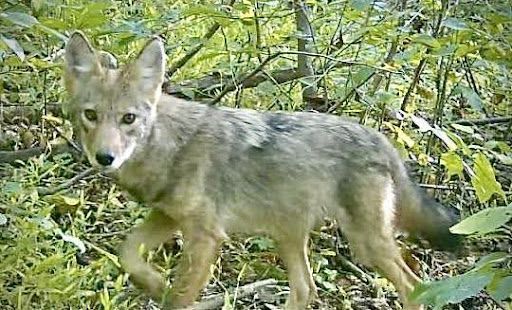
The howls of coyotes along the AT can make you want to stay inside your tent at night. If it seems like there are a lot more of them howling now than in the past, you are right. Coyotes only began making their way into our area in the late 1980s. They are now the dominant predators in most of the eastern United States and Canada, and they are here to stay. However, the more you learn about them, the less concerned you may become. They are most active after dark, but flexible about hunting during the day if they need to. The coyote in the above photo was hunting near the AT in Duke Hollow (northern Virginia) on October 3, 2025. It was probably a young adult hunting solo. Notice its dark-tipped bushy tail, tall, pointed ears, and narrow snout.
Why do coyotes howl?
A. They are calling other pack members to come together.
B. They are warning other coyotes to stay out of their territory.
C. They are frightening prey animals into the open.
D. A and B
The answer is at the bottom of the page!
Fun Facts and Musings
Coyotes are primarily carnivores, feeding on a wide range of prey: insects, mice, rabbits, and even an occasional deer. Although they are considered pack animals, they typically hunt alone or with one or a few family members. Their social groups are families—usually a mother and father with their offspring. These families establish stable territories that vary in size from 5-25 square miles depending on the amount of food available in an area. The two parents remain together for life. Each year, mother coyotes have a two-month pregnancy during the winter and give birth in the spring. The father brings food to the mother and pups in their den, which is typically underground, in a rocky outcrop, or in a hollow tree. Young coyotes (commonly six pups per litter) grow to full size in about nine months. Both parents feed their offspring until they are able to hunt for themselves. They leave the breeding den permanently in the early summer (June to July). Grown offspring often roam away from their families later in the summer (August).
The successful expansion of coyotes into eastern North America had two main causes: coyotes are unusually resourceful animals and we created a landscape that favors them. The wide range of prey that they hunt is essential, but they are also good scavengers of animal carcasses. In addition, they have a taste for fruit, such as berries. Their success in urban and suburban areas comes from their ability to get part of their nutrition from our garbage. Coyotes are normally most active in the hours after sunset and before dawn. However, to avoid people, they push off their hunting deep into the night when we are asleep.
The great forests that once covered the eastern United States did not suit coyotes; they were animals of the plains and prairies. As European settlers moved westward in the 1800s, they cleared these forests for agriculture and largely eliminated the coyote's competitors (gray wolves and cougars). As a result, two waves of coyotes began to move eastward. One wave of coyotes moved to the northeast around the Great Lakes through Canada toward New England. A second wave of coyotes moved eastward along a front that extended from the Great Lakes south to the Gulf of Mexico.
Coyotes (Canis latrans) look similar to dogs (Canis familiaris) and gray wolves (Canis lupus) because they are closely related and capable of interbreeding. The coyotes in the northeastern U.S. are larger (weighing 30-40 pounds) than those in our area (weighing 20-30 pounds) because of interbreeding between the northeastern coyotes and Canadian gray wolves (weighing 60-145 pounds). Interestingly, the larger northeastern coyotes have been moving south, and are expected to converge with the smaller coyotes in our area. However, recent (2017) testing of over 100 coyotes in Virginia and West Virginia found that roughly 90% of them were still genetically similar to western coyotes. Of course, further mixing of traits from northeastern coyotes and even dogs is to be expected in the future.
The topic of coyotes is fraught with emotion: "They're eating our pets!" "They're hunting our deer!" "They kill people!" Cats and small dogs wandering outdoors in the darkness are easy prey for coyotes. Although there is little information on the numbers of pets and strays that are taken by coyotes in the U.S., even a single lost pet is sure to stir anger towards coyotes.
Hunters often take pride in shooting coyotes, believing that they are killing pests that are hurting the deer population. However, this popular opinion is not supported by the research of wildlife biologists. The roughly 400,000 coyotes shot by hunters each year are quickly replaced by new coyotes moving into the vacated territories, as well as by more baby coyotes. Importantly, coyotes in our area do not usually hunt adult deer or kill enough fawns to make an impact on the deer population. The sick and weak deer that coyotes do kill would likely have died anyway, meaning that the coyotes are not adding substantially to the total number of deer dying each year. This finding led wildlife biologists in Pennsylvania to conclude that coyotes have a negligible impact on the deer population. Even the adult deer eaten by the larger northeastern coyotes in New York were found to be primarily road kills (92% road kills vs. 8% prey).
Finally, are coyotes really a danger to people? No. There have been only two people killed by coyotes in the U.S. in the past 300 years. By comparison, 468 people were killed by dogs in the U.S in just 10 years (2011-2021)!
None of the above argues against the potential local problems or ecological changes that coyotes can cause. The question here is what is the overall impact of this species in the eastern U.S. Certainly, the red foxes wish that coyotes were not here; they get chased around and marginalized where the two species now coexist.
Answer: D!
Coyote calls are remarkably diverse—not just howls, but also barks, yips and other sounds. These vocalizations are their language. They howl to call distant family members together. And, they howl to ward off outside coyotes from their territories. Much like dogs, their barks and yips and growls are used to communicate about danger or for play or aggression. Barking coyotes sound so similar to dogs that you could easily mistake the two, as I have. A video of coyote calls can be seen athttps://youtu.be/l-0aK59t42g. (Some of the scenes are from Canada, showing larger coyotes and even a tussle with a lynx!).
Send your photos and ideas for topics to Ray at rvb@umich.edu.
<<Previous Article Back Home Next Article>>