
"What on Earth?"
Ray Barbehenn
Caterpillars, like most insects, have tiny hairs on their bodies to provide them with a sense of touch. Otherwise, their exoskeletons are about as sensitive as a piece of plastic. However, caterpillars that are covered with long hairs, spines, or bristles are likely using them for self-defense. Sometimes these defenses can make them harmful to touch.
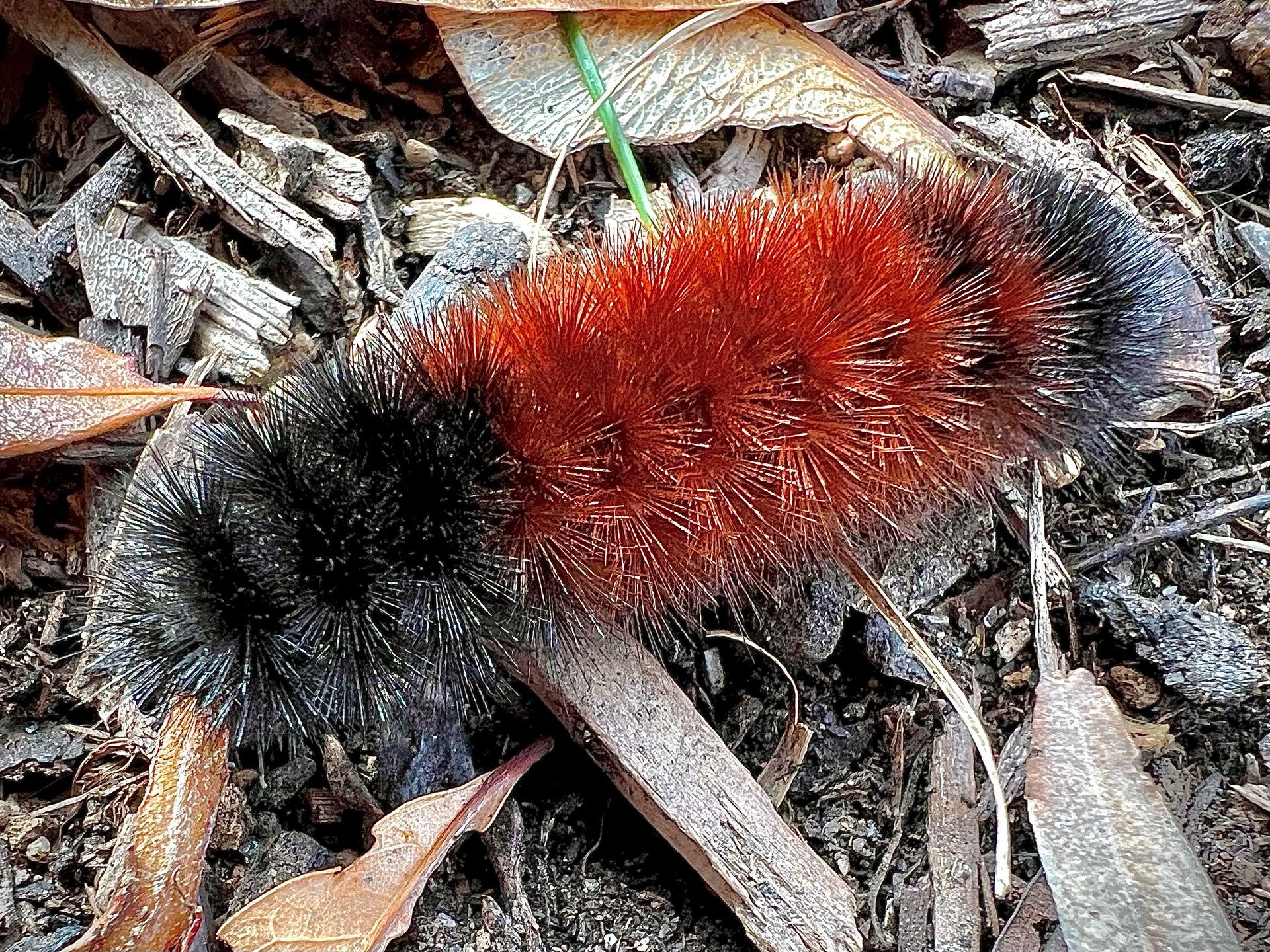
The Woolly Bear caterpillar in the left photo taken by Ray Barbehenn (about two inches long) was galloping across the ground in Duke Hollow (northern Virginia near the AT) on October 26, 2025. This is the time of year when they need to find a safe place to hibernate. Note its bands of stiff black and red-brown bristles. Its head is tucked underneath at the left, partially covered with bristles.
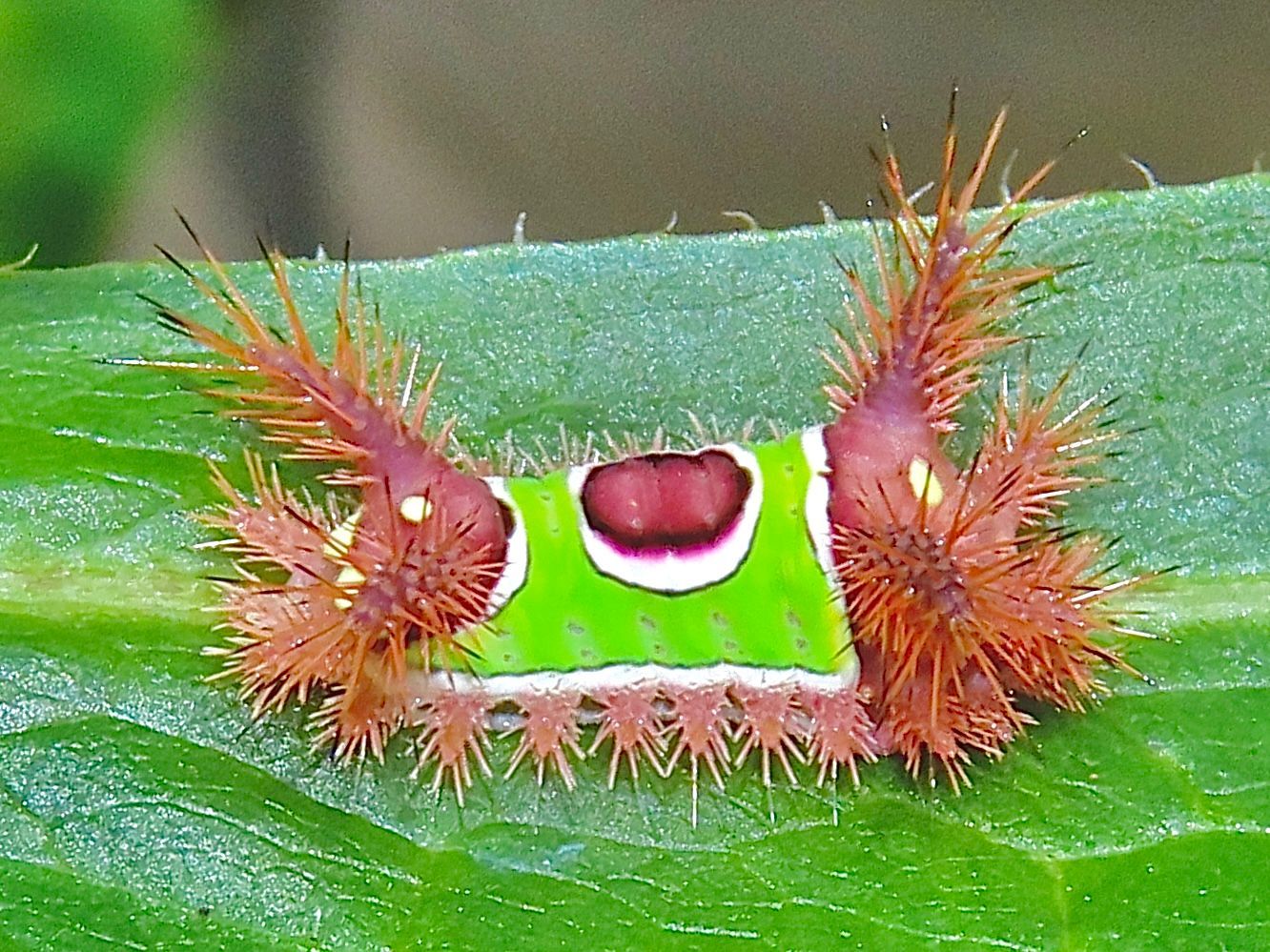
The Saddleback caterpillar in the right photo (about three-fourths of an inch long) was found by David Cox in the foothills of the Blue Ridge (Washington, VA) on August 24, 2024. Its head was tucked under the clusters of spines on the right. Notice the bright white and red-brown eyespot in the "saddle" on its back. It has a low, flattened shape compared to the barrel-like shape of a Woolly Bear.
Which species is dangerous to handle?
A. The Woolly Bear.
B. The Saddleback.
C. Both.
D. Neither.
The answer is near the bottom of the page!
Fun Facts and Musings
The annual running of the Woolly Bears in the fall, as they search for a place to overwinter, has attracted a lot of attention. And, it has led to one obvious question: "How do they survive through the winter?" Most adult insects freeze to death in the winter. The insects that make it through the winter are usually at the stage of an egg or a pupa (a bullet-shaped structure with a hard, protective shell). Woolly Bears are able to overwinter as caterpillars because they make glycerol, a chemical that is similar to the antifreeze in cars and trucks! They make this glycerol by breaking down some of their stored fat. Antifreeze chemicals keep large ice crystals from forming and rupturing the animal's cells. Thus, they are able to thaw out again in the spring without damage from being nearly solid.
Woolly Bears are fully grown when they hibernate in the fall, and they turn into pupae and then moths soon after they emerge in the spring. However, a relative of the Woolly Bear, the Arctic Woolly Bear, needs to keep growing after it emerges from hibernation. A wonderful video of this caterpillar can be seen at https://www.youtube.com/watch?v=eHzEOrtKA1Q. It shows how they withstand seven years of arctic winters before they can finally grow large enough to complete their development into moths.
Forecasting winter weather from the appearance of Woolly Bears is on par with forecasting spring weather by looking at a groundhog's shadow. Supposedly, a wider brown band predicts milder weather, but there has been no scientific research to support this idea. The width of the brown band can vary greatly between the Woolly Bears in one area. Though the internet is full of speculations about what causes the variability in Woolly Bear band width, the cause is not the upcoming winter weather.
Woolly Bears and Saddlebacks have warning coloration – bold colors that are meant to get the attention of would-be predators. It is the opposite of camouflage. Naive predators quickly learn to avoid these caterpillars if they get a mouth full of spines or a painful jolt of poison. Sometimes humans are the naive ones; some toddlers who have tried to swallow Woolly Bears have ended up in the Emergency Room with badly irritated throats! Thus, although Woolly Bears do not sting, their bristles do come off if they are handled roughly. It is not yet known whether Woolly Bears are also defended by toxins that they absorb from some of their food plants. Some of their close relatives (also called "Woolly Bears") do contain toxins from their food plants, and it seems likely that Woolly Bear caterpillars would have toxic defenses to back up their colorful warnings.
A covering of hairs or spines around a caterpillar can be a good defense against predatory or parasitic insects, such as wasps. Yellowjackets and hornets need to be able to get at the surface of a caterpillar to kill it, and parasitic wasps need to land on a caterpillar to lay their eggs inside it. A caterpillar's hairs or bristles can serve as an early warning system: If a wasp touches them, it alarms the caterpillar, causing it to either curl up in a defensive ball or wriggle away violently and escape. Interestingly, though the spines of Saddlebacks are venomous, they do not defend against parasitic wasps as well as a full coat of bristles. Small female parasitic wasps are able to land on the exposed backs of Saddlebacks to inject their eggs. The parasitized Saddlebacks are eaten from the inside by the wasp larvae.
The unpleasant way to find a Saddleback caterpillar is to brush up against one on a leaf. I would compare its sting to that of a wasp, but it will vary with the amount of contact that you have with the caterpillar (the venom dose). Like wasp and bee venom, Saddleback venom evolved to cause pain. (More pain means better survival.) Similarly, your response to the sting can vary from rash-like bumps at the point of contact, to more severe reactions for sensitive or allergic individuals. Some of the more severe symptoms include weakness, nausea and dizziness.
Both Woolly Bear and Saddleback caterpillars can eat a huge range of plant species, including both trees and non-woody plants. Woolly Bear caterpillars prefer to stay on the ground, eating virtually any kind of plant that they run into. Caterpillars usually stay put on one plant for days, if not for their entire lives as caterpillars. The way Woolly Bears move around and graze like little goats is truly remarkable. Saddleback caterpillars prefer to stay in trees and shrubs and are relatively sedentary (normal).
Saddlebacks are also known as "slug" caterpillars. Their flattened bodies and short legs give them an unusually low position. They appear to glide along a leaf surface like a slug. However, they do not secrete mucus and move like a real slug, as is sometimes stated. Instead, Saddlebacks move with a wave-like series of contractions of their body segments from back to front, just like most other caterpillars. See a great video of Saddlebacks crawling athttps://www.facebook.com/TheCaterpillarLab/videos/saddleback-caterpillars/1210924645614151/. Also, notice how they continuously lay down a strand of silk as they move their heads from side to side. This is also normal caterpillar behavior. If they were blown off a leaf, they could hang from this thread.
Answer: B!
Take another look at the spines on the Saddleback. They taper down to sharp black points. In the insect world, structures that are black have typically been hardened. These are not like Woolly Bear bristles; they are meant to penetrate and inflict serious pain. Indeed, the tips of their spines have a weak spot so that they snap off easily, releasing greater amounts of venom and pain in their would-be predators.
Most hairy or bristly caterpillars are safe to handle gently; there are very few species that I would not allow to crawl on my hands. The hairs and bristles of caterpillars do not normally come off and impale your skin if they are just crawling around. If they did, they would get worn off during their daily lives, and they could not grow new ones. However, I have been stung by Saddlebacks, and suggest that any contact with them should be avoided.
Send your photos and ideas for topics to Ray at rvb@umich.edu. Does anyone have a good photo of a Blue Jay, a Crow or a Raven?