
"What on Earth?"
Article by Ray Barbehenn. Photos by David Cox and Ray Barbehenn
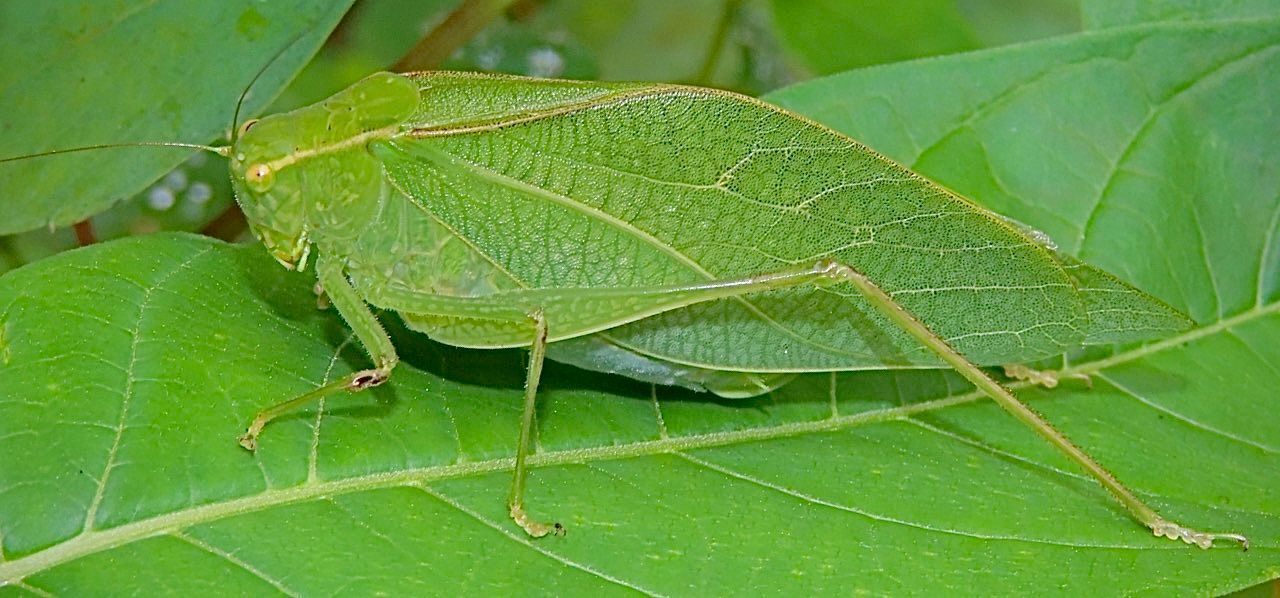
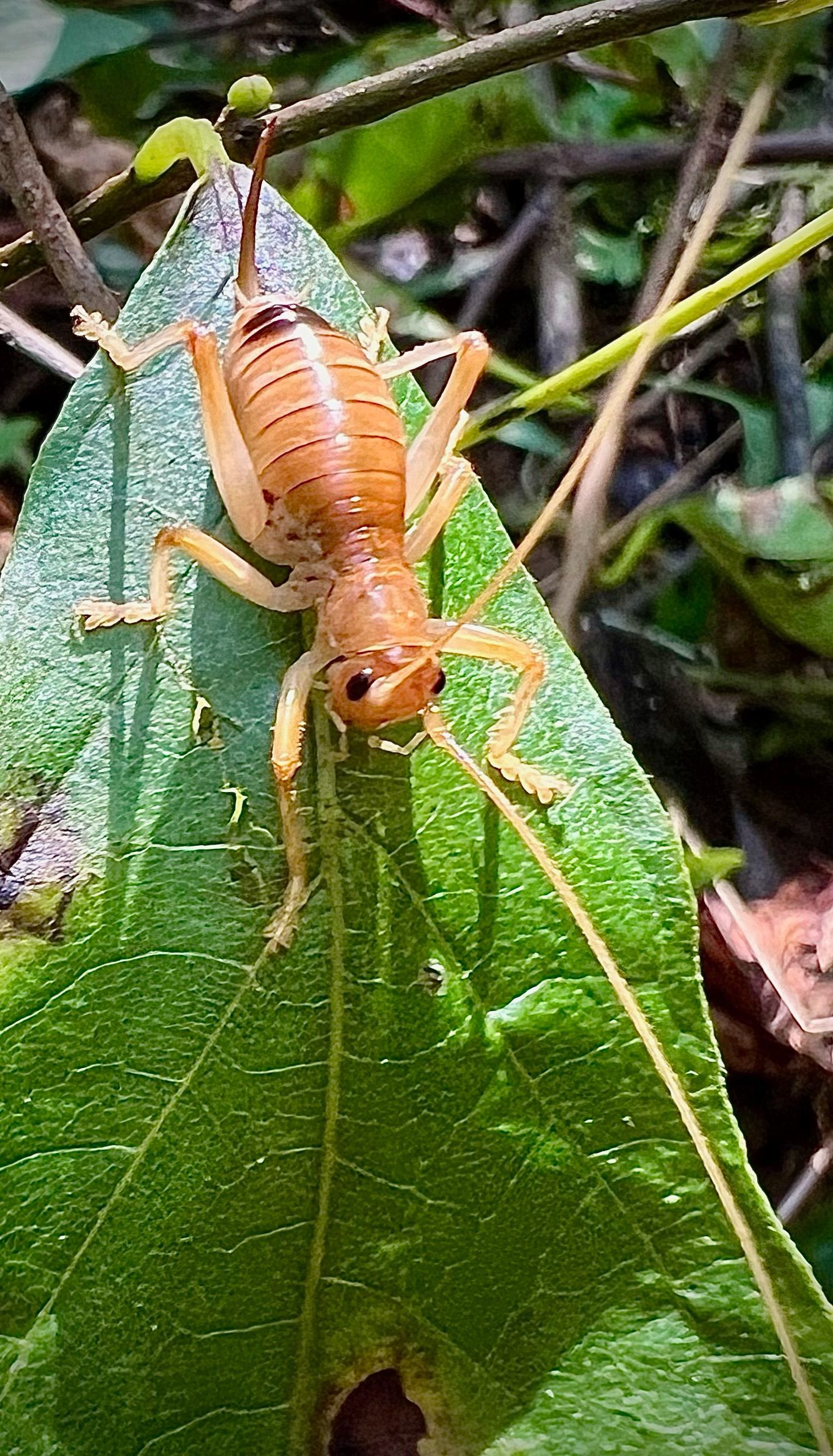
Just about everyone is familiar with grasshoppers, but fewer have seen katydids (left photo), and far fewer know of the Carolina Leaf-roller Cricket (right photo). All of these insects are related, and usually have long hind legs and long, straight wings. Katydids and crickets also have long, hair-like antennae, while grasshoppers have short, stout antennae.
The Greater Angle-wing Katydid in the left photo was almost two inches long from head to tail. It was found by David Cox in SNP on September 11, 2022. Their long wings are held in a tent-like position, forming "angles." Note how the stiff blood veins in its wings add to its impressive leaf-like camouflage. Also notice the dark spot on its front leg, looking almost like the scab on a wounded elbow. This is no wound; it is one of its ears! These are essential for communicating with sound.
The adorable Carolina Leaf-roller Cricket in the right photo was about three-fourths of an inch long. She climbed out of the leaf litter in Duke Hollow (northern Virginia near the AT) on September 28. Unlike the great majority of related species, she is wingless! The sword-like rear end of her body is an "ovipositor" for laying eggs in the ground. This species does not communicate with sound, but both sexes make a "raspy" noise if they are threatened.
How do male katydids make their calls?
A. They rub their hind legs together
B. They vocalize with their mouths.
C. They vibrate their bodies.
D. They rub their front wings together
The answer is near the bottom of the page!
Fun Facts and Musings
Summer nights out in the woods and fields are filled with the sounds of insects – chirping and whirring and clicking. Each species has its own call, just as distinctive as the songs of different species of birds. For example, Common Katydids are named for their calls: "Katy-did, Katy-did," while Greater Angle-wing Katydids make a monotonous series of ticks. Each species makes a unique call simply by varying its pitch, loudness, and repetition rate. A wonderful website to hear the calls of a large variety of insects is:https://songsofinsects.com/katydids/greater-anglewing.
Katydids hear each other with some of the tiniest ears on Earth! Despite their small size, the ears on their front legs function much like our own, with tiny eardrums that vibrate when hit by sound waves. Their ears are sensitive to a broad range of high pitches, usually in the range of 2-150 kHz. (kHz, short for kilohertz, is the measure of sound frequency or pitch.) We can only hear in the range of about 0.02-20 kHz.
Katydids and crickets make their calls by rubbing their front wings together with a scissors-like motion. Specifically, the "file" on one wing is rubbed with the "scraper" on the other wing. The file is named for its appearance – a series of parallel grooves that look like a tiny metal file. The scraper is the stiff edge of a wing or a series of stiff pegs. Think of the file as a plastic hair comb, with sound produced by rubbing your thumb (like a scraper) down the length of its teeth. You can imagine the different calls that could be made by having a hair comb with stiff teeth or thinner, flexible teeth. Similarly, files can have stiff or flexible ridges that make different pitches when rubbed against a scraper. Now, imagine all the variations of calls that an insect could make by brushing its wings together at different speeds, and with different lengths of pauses between strokes, and with different intensities. Some species brush their wings back and forth 100 times a second, while others might rub theirs together only about once a second. By contrast, Carolina Leaf-roller Crickets do not make calls to communicate. They have no wings to brush together. They also have no ears!
Both the Greater Angle-wing Katydid and Carolina Leaf-roller Cricket feed at night. Katydids eat the leaves of a large variety of plants, including many trees. Those adorable little Leaf-Rollers will surprise you: They climb into shrubs and trees to hunt for soft-bodied insects, such as aphids and caterpillars. Whether they also eat leaves is unclear. (This is a little-studied insect.) While sleeping during the day, Katydids are well-camouflaged from predators. Leaf-roller Crickets sleep in small shelters that they usually make out of leaves. This unusual behavior is the reason for their name. However, their most unusual talent is making silk!
The ability to make silk is not found in any of the relatives of Leaf-roller Crickets – not in katydids, crickets, or grasshoppers. There are some other insects that make silk, such as caterpillars, but Leaf-roller Crickets have evolved silk-making on their own, rather than inheriting the ability from a silk-making ancestor that they have in common with the other silk-making insects. The silk in all insects is held in liquid form in their bodies, and only hardens into a strand when it is squeezed out and contacts air. They are tiny, living caulk guns!
Most silk-producing animals use it for a similar purpose: survival. They hide from predators in silk shelters or surround themselves with it while they change into adults. There is no substance like silk: It can be as strong as steel, but lightweight and stretchy. Thus, only a small amount of silk is needed by Leaf-roller Crickets to "roll" or tie together leaves to construct their little shelters.
The unusual features of the Carolina Leaf-rolling Cricket seem strange, in part, because it is the only one of its kind in North America. Sharing the name "cricket" does not mean that they are related to the House Cricket or camel crickets that you might see hopping in your garage or basement. Indeed, Leaf-roller Crickets and House Crickets split apart from a shared ancestor over 300 million years ago! This was long before there were birds – a time when the calls of katydids and true crickets were probably the only animal sounds that would have been heard on land.
Answer: D!
You may have learned that crickets chirp by rubbing their legs together. Not so. True crickets make their calls like katydids do by brushing their outer wings together. Grasshoppers do not rub their legs together either. Grasshoppers make their calls by lifting their legs up and down rapidly, brushing a row of tiny teeth on the inner surface of the hind leg against a hardened wing vein.
Send your photos and ideas for topics to Ray at rvb@umich.edu.
<<Previous Article Back Home Next Article>>