
Crosscut Saw Experience at Centennial Fest
By Paul Boisen
CentennialFest offered a 3-hour 'Crosscut Saw Experience' session on October 3 for people new to crosscut or for experienced crosscut sawyers who wanted to get stuck-in to a good sawyer problem. The session was held at the Wildflower Trailhead area (near Stanley, Va.). It was led by Paul Boisen and Jeff Landis, both of whom are US Forest Service certified sawyers and members of the Shenandoah Mountain Trail Crew (SMTC). The SMTC was formed to support PATC North River District trail maintainers who maintain 104 miles of trail, including all the trails in Ramseys Draft Wilderness, in which chainsaws are prohibited. The SMTC has over 20 USFS certified crosscut sawyers who use their skills in Ramseys Draft and on other trails in the North River District.
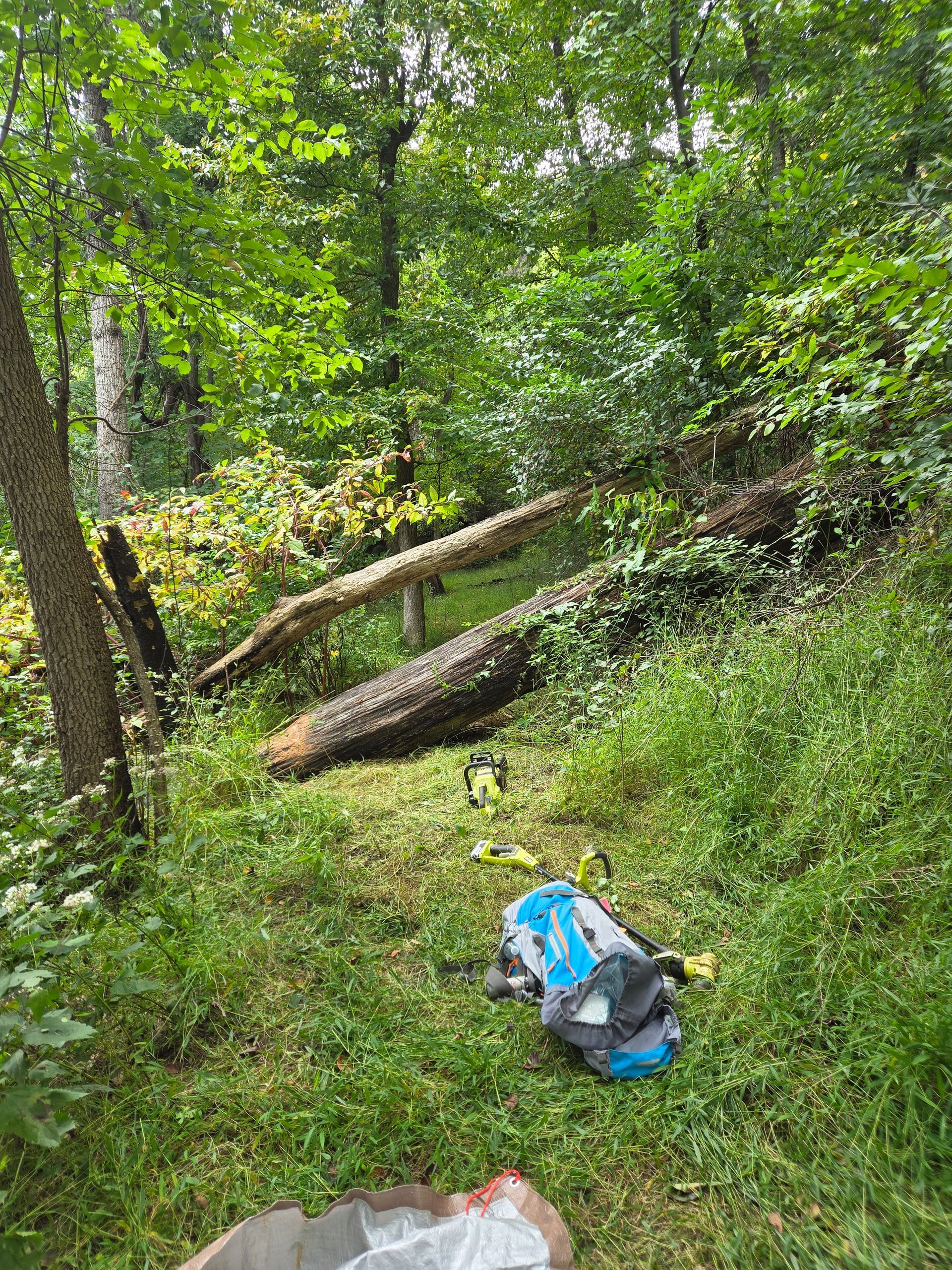
October 3 began with Boisen standing in a steady rain at the trailhead, wondering if anyone was going to come. But at 9AM the rain suddenly stopped and the six participants arrived. After paperwork, the group walked 1,300 feet to the work site (pictured) and had a good conversation about the possible binds, reactive forces, and the order of cuts.
Technical info: the two trunks in the picture are from the same oak tree, whose root ball is upslope. The group sent people up and down to gather info on the tree. The downslope report: both trunks fork; the bottom trunk's forks were well dug-in to the hill downslope and were expected to hold, while the upper trunk's forks had heavy contact with two standing trees, indicating a possible spring loading of those limbs and the possibility that unexpected binds could develop when cut. The upslope report: the root ball seemed stable and both trunks were off the ground. The leads asked the participants to proceed as if there were a danger of spring loading of the branches and rolling of the canopy; the leads also divulged that this tree had been down for a long time and had probably relaxed into its present shape (this turned out to be the case).
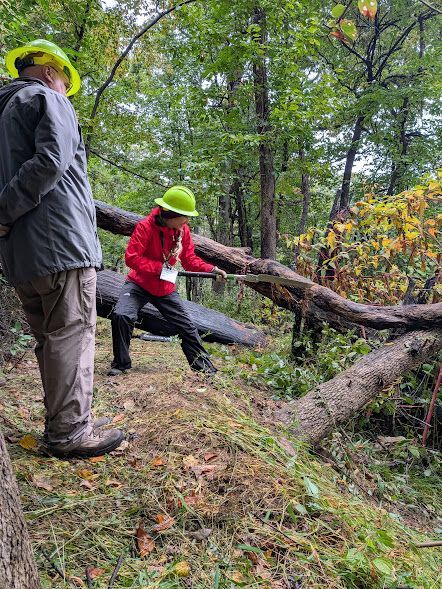
The participants cleared the heavy contacts between the upper trunk and adjacent trees, with lots of good discussion of where the sawyer could safely stand and the possible reactive forces that would activate during each proposed cut. One of these cuts is pictured in-progress. This cut began from underneath, as the author had assessed that the branch (above) pressing down on the tree (at right) would cause the kerf underneath to open nicely. That did happen initially, but then the kerf started closing back up! The reason: as the kerf weakened the branch, its right-hand segment started sliding down the tree at right, creating a side bind condition and causing the sawyer-side of the kerf to close. This meant that the downhill side of the kerf was wide open—but this was not useful, as it was not safe to stand on that side of the log. The team kept at it, and eventually the branch separated.
After clearing the downhill contacts of the upper trunk, the group went up the hill to sever it near the rootball. After this, the trunk was laying on skids previously placed on the trail, so the participants used poles to “row” the heavy 15-foot trunk slowly downhill. After a few minutes of slow progress, the trunk overbalanced and slid down the slope by itself. This is when the rain restarted, and the team packed up after four hours of good work.
Quotes from participants: "I enjoyed how thorough Paul was, explaining the different designs of the saws and where the tension and compression most likely were for all of our cuts. It’s easy to saw without stopping to think first, but that's how you get yourself in a bind." “You definitely made me a better crosscut sawyer and I now can see the benefit of becoming certified. I will seek out those opportunities.” The six participants in the Centennial Fest Crosscut Experience were Tony Alimenti, Roger Christ, Jeff Davis, Sarah DeGennaro, John Helander, and Mark Perschel.
<<Previous Article Back Home Next Article>>