
President's Logbook
By Jim Fetig
In southwest Asia, military ceremonies tend to feature common characteristics. They often occur in a temporary compound circumscribed by painted canvas walls. The dais is decorated with regal potted plants while the soldiers march in their splendid best. After completion, the canvas walls are rolled up and the potted plants carted away until next time.
That’s the origin of the term “potted plant” meaning something of little more than decorative value that stands around to fill blank space. That was my role representing PATC at the visit of King Charles III to the Dickey Ridge Visitor Center in Shenandoah National Park. Fortunately, I’m experienced at this sort of thing and didn’t screw it up.
It was an honor to represent everyone who volunteers as stewards of public land. Charles has been outspoken for decades in his concern for land conservation and climate change. The National Park Service and U.S. Fish and Wildlife Service representatives, including the Secretary of the Interior, were there to discuss his various interests. We potted plants mostly listened.
Highlights of the visit also included swearing in a group of local high school students as Junior Rangers and a long visit with representatives of the Monacan Nation, the First Peoples whose land encompasses much of the area.
Before the King arrived, the students were not impressed. It was obvious they didn’t appreciate what was about to happen. Afterward, they were over the moon. The conversion from stoic cynicism to star-struck excitement was fun to see.
The American delegation was small, hardly more than a couple of dozen in the large visitor center backyard, leaving plenty of space for the buffalo to roam had there been any.
The King’s ride was a black armored BMW. I never figured out why the King of England was driving around in a German car. Maybe he left his carriage and horses at home?
Of interest, the King’s chariot arrived flying the Union Jack on the left fender and the King’s standard on the right. In protocol, anything to the right of something else outranks it. In contrast, in our country, the Stars and Stripes flies on the right fender of the presidential limousine and the president’s flag to the left.
The King’s car door stopped precisely at the flagstone walk in front of the visitor center. As Charles slid from the back right seat, we were struck by how ordinary he appeared. He’d obviously been wearing his light gray suit all day. However, he eagerly embraced the event.
Charles himself is obviously skilled at “meet and greets.” He was warm, funny and full of questions honed by years of experience. His voice was as soft as his 77 years. His lack of pretense dropped the intensity level like a dimmer switch.
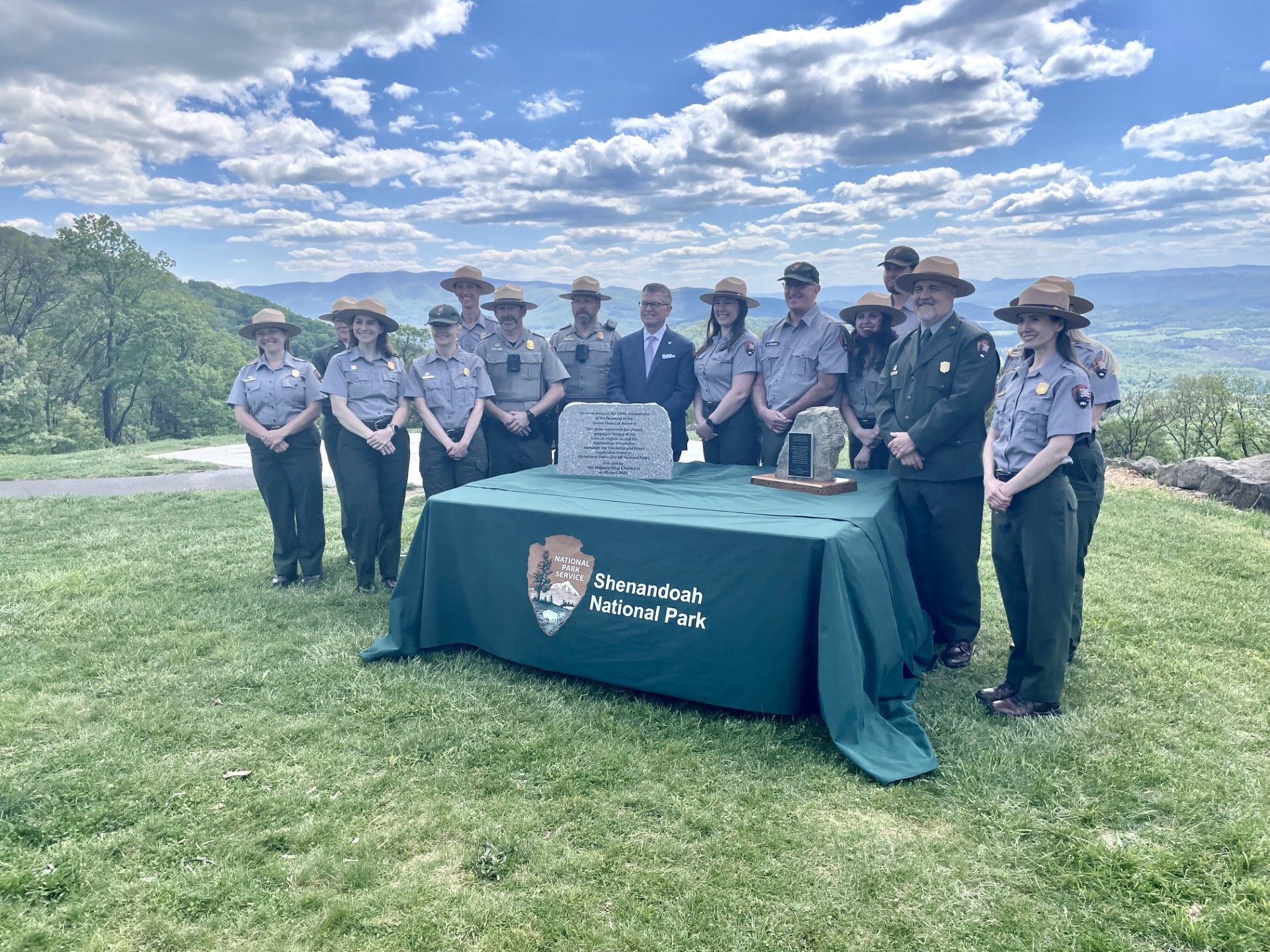
The highlight of the day was an exchange of stones respectively taken from Buck Hollow in Shenandoah and from Cairngorms, the largest National Park in the UK.
The parks share the Appalachian Mountains which are the same on either side of the Atlantic. The Appalachians were once part of Pangea before continental drift split the range in half. The stones symbolize what we have in common.
If you want to see it, the stone Charles presented is on display in the Dickey Ridge Visitor Center. From now on, I’ll secretly think of it as the Charlestone Visitor Center.
By the time his visit was over, Charles III, the King of England, clearly had enjoyed himself as had everyone else who had been part of his visit.
"There is no royal road; you've got to work a good deal harder than most people want to work." -Charles E. Wilson.