
Benton MacKaye and Myron Avery: Two Visions Making One Trail
Matt Waurio, PATC Communications Supervisor
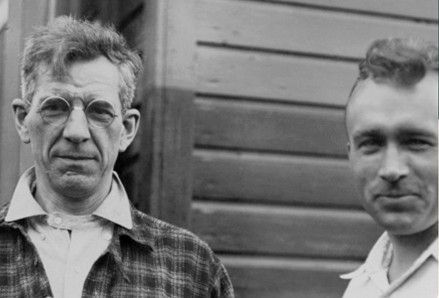
Caught up in the demands of the present, it’s easy to forget the century-long path that led to the trails and cabins we steward today. The labor of thousands of PATC members before us created the conditions in which we now work - for better or for worse. Our stewardship is inherited, but it’s also ongoing.
Along these lines, the Appalachian Trail didn’t emerge from a single vision or personality. Instead, the trail and the systems that support it were shaped by a productive tension between two very different frames of thought: dreamers and doers. Dreamers imagine possible futures; doers work within existing realities to bring projects to completion. These contrasting approaches are embodied by two historically central figures in AT history: Benton MacKaye and Myron Avery. Their differing philosophies forged the trail as we know it today: MacKaye rooted in imagination, regional planning, and social renewal; Avery grounded in execution, policy, and discipline. For the PATC, their contrasting perspectives offers a framework for how the Club continues to balance ideals with action, vision with stewardship, and tradition with adaptation.
As we plan for PATC’s centennial in 2027, we call on both dreamers and doers to help imagine the future of our club for the next 100 years. Benton MacKaye is often credited as the intellectual father of the AT and conceived the project in 1921 as much more than a recreational footpath. His ideas were shaped by the pressures of the early twentieth century: industrialization, urban crowding, and social fragmentation. MacKaye envisioned the trail as a form of regional planning, a spine of wild lands and intentional communities that could counterbalance development trends. In his mind, the trail was a social experiment in human renewal and ecological balance. Hiking was secondary.
Myron Avery, a central figure in PATC’s own legacy, was a pragmatist. A lawyer with seemingly inexhaustible energy and legendary organizational skills, Avery cared little for philosophical abstraction and a great deal for practical outcomes. He focused on where trails existed, where they could be routed, and whether they met clear, enforceable standards. Setting aside many of MacKaye’s broader ambitions, Avery believed the Appalachian Trail should be continuous, clearly marked, and rigorously documented. Where MacKaye saw possibility, Avery saw ambiguity and he worked relentlessly to eliminate it. Under Avery’s leadership, the trail became real: miles were surveyed, blazes painted, maps corrected, and gaps closed.
The tension between these two men was real and, at times, deeply personal. MacKaye worried that Avery’s emphasis on uniformity stripped the trail of its broader social purpose. Avery saw MacKaye’s expansive ideas as impractical and potentially destabilizing. Yet history suggests the AT required both. Without MacKaye, there may have been no unifying vision to inspire a movement. Without Avery, that vision might never have left the page.
PATC emerged and has endured largely by leaning toward Avery’s model. The club embodies his insistence on stewardship, standards, and accountability. Trail sections aren't merely admired; they're maintained. Cabins aren't romantic relics; they're managed assets. Volunteers aren't loosely affiliated enthusiasts; we're trained, organized, and supported. This operational discipline combined with grassroots commitment has allowed PATC to steward a thousand miles of trail and infrastructure for a century. But as we approach our centennial (and perhaps catch our breaths in the tail end of winter months), we might also allow ourselves to be a little more like MacKaye.
The trail network that gives PATC its purpose now faces pressures neither MacKaye nor Avery could have fully anticipated: unprecedented visitation, climate-driven erosion, and shifting patterns of recreation. Addressing these challenges could benefit from more Avery-like rigor - with data-informed decisions, consistent standards, and sustainable maintenance models. But it also demands MacKaye-like imagination: rethinking how people engage with trails, how volunteers are recruited and retained, and how stewardship values are communicated to new generations - what it means, in practice, to belong to PATC.
If you’re interested in sharing your PATC centennial ideas, contact our VP of Volunteerism, Jayne Mayne at jmayne@patc.net. For our hundred-year celebration, no dream is too grand.